Showing posts with label animals. Show all posts

Monday, October 25, 2010

Bee Sniffing Technology Detects Dangerous Vapours

As far back as 1999, the Defence Advanced Research Projects Agency (DARPA) Controlled Biological Systems Program funded a bee-training program to detect buried landmines, so that many thousands of acres of the world's land could be productively farmed without encountering landmines the ugly way.


A bee's natural instinct is to extend its proboscis when it encounters a desirable odour, anticipating the taste of a flower, let's say. But the bees used in the 1999 DARPA experiment were trained, via classical Pavlovian conditioning, to respond to the odour of TNT instead. Their reward when they responded with a Proboscis Extension Reflex (PER), was a taste of sweet syrup. Then, trainers attached small diodes onto the backs of TNT-trained bees and used handheld radar tracking devices to chart where the bees went.

Inscentinal Ltd. has been working on developing very unique sensing instruments that couple the biological performance of honeybees with the technology to translate bee response into an electronic response. Inscentanil's first proprietary design is a hand held device called the VASOR136, a trace vapour detection unit that is very versatile.

The VASOR136 contains 36 cartridges each containing one bee. Filtered in by a standard gas mask cartridge is a constant supply of clean air. When an operator presses a button on the VASOR, an air sample is taken from the environment that exposes the bees to ambient, unfiltered air. If the bees have been trained to respond to a vapour in that air, the bees will exhibit a PER response and the response will be translated by the VASOR into a simple result shown on the PDA screen display.

Read more at: http://www.physorg.com/news188894292.html

New Materials Inspired Spider Webs


New Materials Inspired by Water-Catching Properties of Spider Webs

Based on their research Lei Jiang and colleagues at the Chinese Academy of Sciences in Beijing created an artificial silk that mimics the water collecting abilities of natural webs. Whilst much is known about the strength of webs the scientists were keen to probe the lesser known ability of spider silk to capture and hold onto rain and morning dew – a mechanism that saves a spider from having to find a water source.

Using a powerful scanning electron microscope and a light microscope the team studied how the spider silk changes its structure when it becomes soaked in water vapour.
At the nanoscale dry spider silk resembles a necklace-like structure. It is formed from hydrophilic knots of silk connected by smooth and slender stretches known as joints. When water condenses on these knots they shrink into densely packed structures that are shaped like spindles. Moist droplets that hang from the spaces in between are drawn toward their nearest spindle-knot, where they gather in larger droplets. The difference in texture between the rough knots and the smooth joints aids the water movement.

Following this research Jiang’s team fabricated fibers that copied these properties. To do this artificial silks were formed by coating nylon fibers with poly(methylmethacrylate)/N,N-dimethylformamide-ethanol, which dries in tiny knots just like those in real spider silk. “Our artificial spider silk not only mimics the structure of wet-rebuilt spider silk but also its directional water collection capability,” the scientists claim.

The new material could be used to upgrade fog-catching nets such as those deployed in the coastal Andes that are providing people with water that they otherwise don't have access to. If the technology is commercialized it could be of great to benefit to communities living in rain-starved areas of the world.

Genetically Engineered Tadpoles glow to indicate Pollution

Genetically Engineered Glowing Tadpoles Detect Pollution

A new environmental monitoring system. Tadpoles have been genetically engineered to express a protein that lights up like a fairground in the presence of pollutants.

Researchers in France and a University of Wyoming professor have developed an innovative application of the technology by genetically engineering tadpoles to monitor heavy metal pollution in water. The system offers a way of rapidly detecting the physiological effects of environmental pollutants and is cheaper and more convenient than traditional means.

In this new approach African clawed frog tadpoles (Xenopus laevis) are modified with jellyfish genes so that they fluoresce when exposed to toxins. They light up in response to dosages that could be harmful to a human, and can indicate the presence of several different types of chemicals at the same time. Some tadpoles have been engineered to glow in the presence of metals, and others in response to plastics.

The scientists involved in this project are already looking to future applications for their tadpole technology. They believe the genetically engineered animals could be deployed to detect toxins in food. Foodstuffs could be turned into liquid and put into the aquarium.

In addition, future genetically engineered tadpoles could fluoresce different colors depending on the pollution they encounter. This requires genes that fluoresce different colors such as some coral genes that glow red.

Read more at: http://www.usnews.com/science/articles/2009/12/28/engineered-glowing-tadpoles-detect-pollution.html

Dolphins can turn off and on diabetes

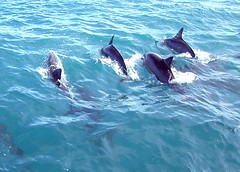
Dolphin CrestImage by jurvetson via Flickr

Dolphins have the ability to turn off and on diabetes, scientists have found, a discovery that could help medical researchers to treat type 2 diabetes.

Dolphins can induce diabetes when there is little food around and turn it off when food is abundant, the researchers found. They believe it is a unique ability and results from the mammal's need to maintain high blood sugar levels to feed its big brain.

They also believe that humans had the ability but lost it through evolution and that studying dolphins could lead to techniques to re-activate it.
A team lead by Dr Venn-Watson regularly studied the blood samples of the dolphins off the San Diego coast and found that they could induce type II diabetes at times of fasting and then almost immediately turn it off again when food became available.

"Dolphins in the ocean go in to feast or famine situations. They will eat a bunch of fish at once and then they may go a while and fast and not eat. During that fasting state they need a mechanism to keep sugar pumping around their blood," she said.

Dr Venn-Watson believes that the ability dates back to when dolphins reverted from land animals to sea animals 55 million years ago and had to adapt to a protein-only fish diet, the Telegraph reported.

There was evidence that humans have done the same during the last ice age when they had to rely on a protein rich diet because all carbohydrate rich foods had been frozen, she said.

Read more at: http://news.bbc.co.uk/2/hi/8523412.stm

Enhanced by Zemanta

Monday, October 5, 2009

Monkeys cured of colour blindness- next target humans


Scientists cure colour blindness in monkeys - humans next?
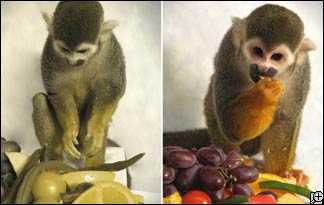
Researchers have delivered promising results by successfully treating two squirrel monkeys with defective colour perception using a gene therapy that could also safely eradicate colour blindness in humans. Millions of people around the world, including 3.5 million Americans, 13 million people in India and 16 million in China, are affected by colour blindness. It is a congenital problem, largely experienced by men, that renders its sufferers incapable of discerning mainly red and green hues: seemingly trivial but, in reality, a necessity for everyday practicalities such as recognizing traffic lights.

According to Jay Neitz, professor of ophthalmology at the University of Washington, “Nothing happened for the first 20 weeks…but we knew right away when it began to work. It was as if they woke up and saw these new colours. The treated animals unquestionably responded to colours that had (previously) been invisible to them.” It has taken more than 18 months of testing the monkeys' ability to discern 16 hues, with some varying as much as 11-fold in intensity. The monkeys were able to trace colour patterns on a computer touch screen and, when they chose correctly, they were rewarded with grape juice.

Read more at: http://www.gizmag.com/scientists-cure-color-blindness-in-monkeys/12881/?utm_source=Gizmag+Subscribers&utm_campaign=2f43e924c1-UA-2235360-4&utm_medium=email

Tuesday, September 15, 2009

Flow Sensors Based on Hair Structures of Blind Cavefish


Researchers Develop Flow Sensors Based on Hair Structures of Blind Cavefish:

A blind fish that has evolved a unique technique for sensing motion may inspire a new generation of sensors that perform better than current active sonar.
Although members of the fish species Astyanax fasciatus cannot see, they sense their environment and the movement of water around them with gel-covered hairs that extend from their bodies. Their ability to detect underwater objects and navigate through their lightless environment inspired a group of researchers to mimic the hairs of these blind cavefish in the laboratory.

While the fish use these hairs to detect obstacles, avoid predators and localize prey, researchers believe the engineered sensors they are developing could have a variety of underwater applications, such as port security, surveillance, early tsunami detection, autonomous oil rig inspection, autonomous underwater vehicle navigation, and marine research.

Vladimir Tsukruk and graduate students Michael McConney and Kyle Anderson conducted preliminary experiments with a simple artificial hair cell microsensor. “After covering the hair cell with synthetic cupula, our bio-inspired microsensor had the ability to detect flow better than the blind fish. The fish can detect flow slower than 100 micrometers per second, but our system demonstrated flow detection of several micrometers per second”, said Tsukruk.

Read more at: http://www.gtresearchnews.gatech.edu/newsrelease/blind-cavefish.htm

Thursday, September 3, 2009

Antifreeze protein inspired by fleas to help humans

A new antifreeze protein discovered in tiny snow fleas by Queen’s University researchers may lengthen the shelf life of human organs for transplantation.

Drs. Laurie Graham and Peter Davies, from the Department of Biochemistry, found that the potent protein produced by the fleas to protect themselves against freezing is capable of inhibiting ice growth by about six Celsius degrees. This would allow organs to be stored at lower temperatures, expanding the time allowed between removal and transplant.

The results of the Queen’s study, funded by the Canadian Institutes for Health Research (CIHR), are published today in the international journal Science.

“Transplant organs must now be kept at the freezing point or slightly warmer,” says Dr. Graham. “If we can drop the temperature at which the organ is safely stored, there will be a longer preservation period.”

The hyperactive antifreeze protein produced by snow fleas is different from two other insect proteins discovered earlier at Queen’s, the researchers say.

“Unlike the antifreeze proteins in beetles and moths, AFPs in snow fleas break down and lose their structure at higher temperatures,” explains Dr Davies, Canada Research Chair in Protein Engineering. “This means that if used to store organs for transplants, they will be cleared from a person’s system very quickly, reducing the possibility of harmful antibodies forming.”

Also Scientists in Illinois and Pennsylvania are reporting development of a way to make the antifreeze protein that enables billions of Canadian snow fleas to survive frigid winter temperatures.

Read more at: http://www.physorg.com/news135863044.html
Also Read: http://www.innovations-report.com/html/reports/life_sciences/report-50696.html

Wednesday, July 29, 2009

A robo pet which can see, hear, and feel

PleofotoImage via Wikipedia

A solution for parents whose kids want a pet, and they don’t – A robo? A pet? = Pleo

The most lifelike robotic pet can see, hear, and feel your touch. Six computer chips process the input and produce lifelike reactions, such as crying if it’s left in the dark. Pleo moves naturally using 28 motors and joints—for example, arching its back when stroked. The dino also learns from experiences (such as staying away from your noisy canary) and displays emotions. You can even download behavioral-modification packs or use the free programming kit to customize its personality. $350; pleoworld.com

Every Pleo is autonomous. Each one begins life as a newly-hatched baby Camarasaurus, but that's where predictability ends and individuality begins. Like any creature, Pleo feels hunger and fatigue - offset by powerful urges to explore and be nurtured. He'll graze, nap and toddle about on his own -when he feels like it! Pleo dinosaur can change his mind and his mood, just as you do.

Unveiled on February 7, 2006, the company has stopped making new pleo’s as of April 17th, 2009. Will this amazing product revive?

Check the website: http://www.pleoworld.com/
Read more at: http://en.wikipedia.org/wiki/Pleo
Check video at: http://www.youtube.com/watch?v=F6LCEFr8SxQ&NR=1&feature=fvwp

In 2005, Senario proudly introduced a distribution deal with Ugobe. Currently, Senario is the only distributor in the U.S. with Pleo stock. Currently Pleo is available on Amazon.com at http://www.amazon.com/Pleo-Dinosaur-UGOBE-Life-Form/dp/B000RWEGCO. There’s even a cool 2.5 minute video about the creation of the lovable dinosaur.

Pleo will also be available for purchase at the Sharper Images online store in September. The retail price is $349.99.


Reblog this post [with Zemanta]

A robo pet which can see, hear, and feel

PleofotoImage via Wikipedia

A solution for parents whose kids want a pet, and they don’t – A robo? A pet? = Pleo

The most lifelike robotic pet can see, hear, and feel your touch. Six computer chips process the input and produce lifelike reactions, such as crying if it’s left in the dark. Pleo moves naturally using 28 motors and joints—for example, arching its back when stroked. The dino also learns from experiences (such as staying away from your noisy canary) and displays emotions. You can even download behavioral-modification packs or use the free programming kit to customize its personality. $350; pleoworld.com

Every Pleo is autonomous. Each one begins life as a newly-hatched baby Camarasaurus, but that's where predictability ends and individuality begins. Like any creature, Pleo feels hunger and fatigue - offset by powerful urges to explore and be nurtured. He'll graze, nap and toddle about on his own -when he feels like it! Pleo dinosaur can change his mind and his mood, just as you do.

Unveiled on February 7, 2006, the company has stopped making new pleo’s as of April 17th, 2009. Will this amazing product revive?

Check the website: http://www.pleoworld.com/
Read more at: http://en.wikipedia.org/wiki/Pleo
Check video at: http://www.youtube.com/watch?v=F6LCEFr8SxQ&NR=1&feature=fvwp


Reblog this post [with Zemanta]

Sunday, July 19, 2009

Wind turbine inspired by whales!


WhalePower's new wind turbine technology owes its performance to what it has learned from from studying just what makes the humpback whale so aerodynamic.The average humpback whale weighs about 36 tons, yet it is one of the most graceful swimmers, divers, and jumpers in the sea.

Frank Fish, whose field is biomechanics, actually came about his observations of the humpback whale serendipitously when he saw a sculpture of a humpback with what he thought were misplaced tubercles on the whale's flipper. The artist had placed them on the "leading" edge of the flipper, not on the underside of the flipper, where Fish "knew" they should be because of his study of fluid dynamics (i.e, smooth edges are most aerodynamic).
The artist was correct, however, and Fish's further research indicated that at least part of the science of fluid dynamics was wrong. The tubercle placement on the humpback whale's flippers and tail is a major part of the reason the great mammal is so aerodynamic - or as MIT's Technology Review called it, hydrodynamic.
The technology, licensed by Envira-North Systems Ltd, first became available in energy saving fans, ventilators (Hurricane turbines), and even curtains.

Now WhalePower is applying its TubercleTechnology to create wind turbines.
This tubercle design operationally keeps air attached to the blades, thereby managing the flow of air and increasing the lift of the blade -- two areas of concern in the development of wind turbines. To date, in fact, no wind turbine performs better in low wind conditions; low wind can literally shut down a smooth-edged turbine. Additionally, Tubercle Technology offers quieter operation, greater stability, and with little to no tip stalling.
WhalePower's Tubercle Technology is one of the finalists of the INDEX Awards 2009.

To read more go to: http://www.enviranorth.com/whalepower.html

Thursday, July 9, 2009

A Robotic Bat Built from Smart Materials

Robo-bats With Metal Muscles May Be Next Generation Of Remote Control Flyers
Researchers hope to use the tiny flying machine for surveillance.

Researchers at North Carolina State University have created a small robotic bat using "smart" materials.

Micro-aerial vehicles can maneuver in small spaces and could be ideal for surveillance tasks. Robert Wood at Harvard has worked for nearly a decade on a robotic fly, and researchers in Germany and England are building dragonfly robots. But designing and building such small flying machines is tricky. They tend to be aerodynamically inefficient, and it's hard to mimic movements like the flapping of wings mechanically.
To create their "robo-bat," the NC State researchers analyzed a bat's muscular and skeletal system, and then used rapid prototyping technologies and smart materials to recreate it.

Seelecke explains that the research team is also using smart materials for the muscular system. "We're using an alloy that responds to the heat from an electric current. That heat actuates micro-scale wires the size of a human hair, making them contract like 'metal muscles.' During the contraction, the powerful muscle wires also change their electric resistance, which can be easily measured, thus providing simultaneous action and sensory input. This dual functionality will help cut down on the robo-bat's weight, and allow the robot to respond quickly to changing conditions--such as a gust of wind--as perfectly as a real bat."
Read more at: http://www.sciencedaily.com/releases/2009/07/090707093625.htm

Monday, June 15, 2009

'Beehive fence' deters elephants

'Beehive fence' deters elephants : SIMPLE BUT EFFECTIVE
A simple fence made from wood, wire and beehives can deter elephants from raiding farmers' crops. A pilot study in Kenya has shown that such fences reduce the number of raids by elephants by almost half. The work is the culmination of previous research which showed elephants are naturally scared of African honey bees.

A much larger trial is now under way in the hope the fences will provide an elegant solution to years of conflict between elephants and farmers. In Kenya, elephants are not confined to national parks or reserves. As they roam, they often come across increasing numbers of farms created by pastoralists who are being encouraged to settle down and grow crops.

The elephants break into the farms and raid them for food such as ripe tomatoes, potatoes and maize. That causes significant economic damage and conflict with farmers who occasionally resort to shooting, spearing or poisoning elephants to protect their livelihoods and families.
So researchers from a British university worked with the charity Save the Elephants to conduct a pilot study of a novel "beehive fence". The design is based on the idea that elephants are wary of honey bees in the wild. In 2002, University of Oxford zoologist Fritz Vollrath discovered that elephants avoided trees with beehives in. Colleague Lucy King followed this idea up by showing that elephants would quickly move on even if they heard the sound of a buzzing hive.
Now a team led by King, including Vollrath, has taken the idea to its logical conclusion - the creation of a fence containing beehives. In the Ex-Erok community in the southern region of Laikipia, Kenya, the team recruited farmers whose crops were regularly raided by elephants. Around the side of one farm, nine traditional log beehives were hung under small thatched roofs, with each being linked by wire. In all, the fence continued for 90m with each hive 10m apart. The hives were left empty.

Algae could give biofuels

NASA Envisions "Clean Energy" From Algae Grown in Waste Water

NASA scientists have proposed an ingenious and remarkably resourceful process to produce "clean energy" biofuels, that cleans waste water, removes carbon dioxide from the air, retains important nutrients, and does not compete with agriculture for land or freshwater.

Algae are similar to other plants in that they remove carbon dioxide from the atmosphere, produce oxygen as a by-product of photosynthesis, and use phosphates, nitrogen, and trace elements to grow and flourish. Unlike many plants, they produce fatty, lipid cells loaded with oil that can be used as fuel.

"The inspiration I had was to use offshore membrane enclosures to grow algae. We're going to deploy a large plastic bag in the ocean, and fill it with sewage. The algae use sewage to grow, and in the process of growing they clean up the sewage," said Jonathan Trent, the lead research scientist on the Spaceship Earth project at NASA Ames Research Center, Moffett Field, Cali.

It is a simple, but elegant concept. The bag will be made of semi-permeable membranes that allow fresh water to flow out into the ocean, while retaining the algae and nutrients. The membranes are called "forward-osmosis membranes." NASA is testing these membranes for recycling dirty water on future long-duration space missions. They are normal membranes that allow the water to run one way. With salt water on the outside and fresh water on the inside, the membrane prevents the salt from diluting the fresh water. It's a natural process, where large amounts of fresh water flow into the sea.

Floating on the ocean's surface, the inexpensive plastic bags will be collecting solar energy as the algae inside produce oxygen by photosynthesis. The algae will feed on the nutrients in the sewage, growing rich, fatty cells. Through osmosis, the bag will absorb carbon dioxide from the air, and release oxygen and fresh water. The temperature will be controlled by the heat capacity of the ocean, and the ocean's waves will keep the system mixed and active.

When the process is completed, biofuels will be made and sewage will be processed. For the first time, harmful sewage will no longer be dumped into the ocean. The algae and nutrients will be contained and collected in a bag. Not only will oil be produced, but nutrients will no longer be lost to the sea. According to Trent, the system ideally is fail proof. Even if the bag leaks, it won't contaminate the local environment. The enclosed fresh water algae will die in the ocean.

The bags are expected to last two years, and will be recycled afterwards. The plastic material may be used as plastic mulch, or possibly as a solid amendment in fields to retain moisture.

For full article read: http://www.nasa.gov/centers/ames/news/features/2009/clean_energy_042209.html

Tuesday, June 9, 2009

SEE THROUGH FISH- to help study cancer

Scientists Create See-Through Fish, Watch Cancer Grow:

A newly bred fish bares all in the lab, revealing brain, heart and other internal organs in the name of research.
Scientists are breeding zebrafish with see-through bodies in order to make studying disease processes easier, including the spread of cancer.
The transparent fish, described in the Feb. 7 issue of the journal Cell Stem Cell, are allowing researchers at Children's Hospital Boston to directly view fish's internal organs and observe processes such as tumor growth in real-time in living organisms.
Scientists previously studied disease in the embryos of zebrafish, which are naturally transparent. But their clear bodies turn opaque when they grow into adults. The newly created zebrafish stays transparent throughout its lifetime.

Traditionally, researchers have relied on information collected after the diseased animal died to infer anything about human ailments. But for rapidly changing processes such as cancer, this snapshot method is bound to miss something. "It's like taking a photograph when you need a video," said White, also an instructor of medicine at the Dana-Farber Cancer Institute in Boston.
White created the transparent fish, which he nicknamed Casper, by mating two existing zebrafish breeds, one that lacked a reflective skin pigment and the other without black pigment. The offspring had only yellow skin pigment, essentially appearing clear.
In one experiment, White and his colleagues inserted a fluorescent melanoma tumor into the abdominal cavity of the transparent fish. By observing the fish under a microscope, they found that the cancer cells started spreading within five days. White could actually see individual cells spreading.
"The process by which a tumor goes from being localized to widespread and ultimately fatal is the most vexing problem that oncologists face," White said. "We don't know why cancer cells decide to move away from their primary site to other parts in the body."
The spreading melanoma cells appeared to flock toward the skin after leaving the abdominal cavity. "This told us that when tumor cells spread to other parts in the body, they don't do it randomly," White said. "They know where to go."

Read more at: http://cosmiclog.msnbc.msn.com/archive/2008/02/06/644161.aspx

Monday, May 25, 2009

Naturally innovative: A briefing paper for the construction industry

HoneycombImage by justus.thane via Flickr


The construction industry and its clients are increasingly being challenged to achieve cost savings and better performance of built assets. Biomimetics has already shown its potential to help with these issues.

Biomimetic ideas and products have the potential to help the construction industry and its clients with demands for:
• Reduced embodied energy (CO2) in construction products
• Reduced materials use, better resource efficiency and hence lower cost
• Reduced weight and complexity (lighter structures, response to manual handling regulations, etc)
• Novel designs
• Reduced maintenance burdens (intervals and costs).

Some examples of its usage include:

Project type Commercial examples of biomimetics Biological analogue
Housing Self-cleaning façade paints Lotus leaf structure
Buildings – commercial and industrial Self-cleaning façades paints and glasses,
Architectural features or structures (such as Stuttgart airport) Lotus leaf structure

Branching tree structures
Logistics Delivery logistics software Interactions within ant colonies
Pavements, roads, car-parks, airports etc Catseyes® Optical reflectivity of cats eyes
Civil Engineering structures (e.g. bridges, tunnels) Tensairity® beams Plant cell wall structures

Please follow the link to read this very interesting paper: http://www.bre.co.uk/filelibrary/cap/Biomimetics.pdf


Reblog this post [with Zemanta]

Tuesday, March 17, 2009

Air-Conditioning lessons from Termite Mounds

What termites can teach us about architecture

The termites keep a constant temperature of 30 ° C inside their mound while the outside temperature fluctuates between 2 ° C and 40 ° C, the difference between day and night. The termites achieve this remarkable feat by constantly opening and closing a series of heating and cooling vents throughout the mound over the course of the day. With a system of carefully adjusted convection currents, air is sucked in at the lower part of the mound, down into enclosures with muddy walls, and up through a channel to the peak of the termite mound. The industrious termites constantly dig new vents and plug up old ones in order to regulate the temperature.


In Harare, Zimbabwe, a business complex was built, Easgate, with large windows, which in principle is not very appropriate in that warm climate. But the architect Mick Pearce designed a passive system of ventilation and air-conditioning channels along the lines of termite mounds, resulting in a saving of 90% of energy. The construction, which was completed in 1996, consists of two towers which are separated by a ventilated patio. The air in the patio circulates inside the towers and provides cooling in the offices. There is no air conditioning but fans and virtually no heating.

Thursday, January 29, 2009

Rent a movie/ car/ house/ ANIMALS???

Rent-a-friend in Japan : Can’t afford a full time pet? Rent one…
Lola is a Persian cat who works at the Ja La La Cafe in Tokyo's bustling Akihabara district. It is one of a growing number of Cat Cafes in the city which provide visitors with short but intimate encounters with professional pets.
There are more than 150 companies in Tokyo which are licensed to hire out animals of various kinds and although beetles may be cheap, dogs are much more popular. First you pay a deposit and a hire fee. Then you are issued with a leash, some tissues and a plastic bag and given some advice on how to handle your new friend.
The right pet ? It costs about £8 ($10) an hour to spend time in a Cat Cafe.


Check this really interesting story at: http://news.bbc.co.uk/2/hi/programmes/from_our_own_correspondent/7818140.stm

Wednesday, January 28, 2009

Robo Squirrel spies on Real squirrels!

ROBO ANIMALS aid behaviour research

Dubbed "Rocky'' after the cartoon character, the robo-squirrel is working its way into Hampshire's live-squirrel clique, controlled by researchers several yards away with a laptop computer and binoculars.
Sarah Partan, an assistant professor in animal behaviour at H ampshire, hopes that by capturing a close-up view of squirrels in nature, Rocky will help her team decode squirrels' communication techniques, social cues and survival instincts.
Rocky is among many robotic critters worldwide helping researchers observe animals in their natural environments rather than in labs. The research could let scientists better understand how animals work in groups, court, intimidate rivals and warn allies of danger.
In Indiana, for instance, a fake lizard shows off its machismo as researchers assess which actions intimidate and which attract real lizards. Pheromone-soaked cockroach counterfeits in Brussels, meanwhile, exert peer pressure on real roaches to move out of protective darkness.

Check the article: http://www.msnbc.msn.com/id/24410638/

Zoo Animals Try Online Dating

Zoo Animals Try Online Dating
Katrina A. Goggins, Associated Press. Columbia.

Just like the digital dating services that pair up people, so-called studbooks are used to match most animals held in captivity. The databases containing information on sex, age and weight -- not so much about favorite comfort foods or long walks on the beach -- are used by more than 200 zoos nationally and some internationally. They're practically taking the place of Mother Nature in the not-so wild world of captive animal breeding.

Now, new software is going to the Web, promising more easily accessible data, faster matches and -- in a page out of the most particular of human dating sites -- details on an animal's personality to ease what can be a testy process. At the very least, though, the software will give zookeepers better access to species-level details currently found only in zoo husbandry manuals that now are mostly e-mailed back and forth, said Bob Wiese, director of collections for the Zoological Society of San Diego.
Around since the 1980s in paperback form, most of today's studbooks are in computerized databases. Basic information such as family tree, medical history, age and weight are entered by studbook keepers, then sent to a central location where the data is analyzed and converted into a "master plan" for breeding. But the databases have their limitations. They aren't updated quickly and don't include the extra information on setting the optimal conditions for an animal's breeding.
"It's really about us gathering the best scientific information we can get to make the best decisions about the long-term viability of our populations," Wiese Said.

Check the whole article at: http://dsc.discovery.com/news/2008/09/09/animal-zoo-mating.html

Monkey replaces men as waiter

We’ve heard of hi-tech hotels, classy restaurants, this one beats them all..
Your next drink will be served by a Monkey!
The Kayabukiya Tavern, north of Tokyo has employed and trained Monkey’s to wait tables. They were the tavern owners pets, but when they began to get stuff for him around the house, he decided to hire them for PEANUTS!!
Video of simians serving drinks and hot towels in a Japanese restaurant became a hit on YouTube, where a news clip circulated in which the restaurant owner, Kaoru Otsuka, said he did not teach the monkeys waiting skills. Apparently, they learned by observing humans.
Although the macaques work only two hours a day, they never get any days off.

Check the story at: http://www.dailymail.co.uk/news/worldnews/article-1071289/Pictured-The-amazing-monkey-waiters-serve-tables-Japanese-restaurant.html

Youtube video: http://in.youtube.com/watch?v=O1DBuFgt_Ug