Showing posts with label Autos. Show all posts

Monday, October 25, 2010

Choose the noise your car makes

Hybrid Cars May Include Fake Vroom For Safety

For decades, automakers have been on a quest to make cars quieter: an auto that purrs, and glides almost silently in traffic. They have finally succeeded. Plug-in hybrid and electric cars, it turns out, not only reduce air pollution, they cut noise pollution as well with their whisper-quiet motors.

But that has created a different problem. They aren't noisy enough.

So safety experts, worried that hybrids pose a threat if pedestrians, children and others can’t hear them approaching, want automakers to supply some digitally enhanced vroom. Indeed, just as cell phones have ring tones, "car tones" may not be far behind - an option for owners of electric vehicles to choose the sound their cars emit.

Working with Hollywood special-effects wizards, some hybrid auto companies have started tinkering in sound studios, rather than machine shops, to customize engine noises. The Fisker Karma, an $87,900 plug-in hybrid expected to go on sale this year, will emit a sound, pumped out of speakers in the bumpers, that the company founder, Henrik Fisker, describes as "a cross between a starship and a Formula One car."

Read more at: http://www.nytimes.com/2009/10/14/automobiles/14hybrid.html?_r=2&ref=technology\

Tuesday, December 8, 2009

Self Healing Paint for cell phones


Self-Healing Paint Headed to Japanese Cell Phones

Nissan recently licensed its Scratch Shield paint, which is scratch resistant and even repairs fine scratches, to Japanese cell phone company NTT DoCoMo. The paint has been used on select Nissan and Infiniti cars worldwide since 1995, but this is the first time it will be used outside of the vehicle market. Unlike the vehicle paint, cell-phone scratch-proof paint will only be available in Japan for now. But considering the wear and tear that most cell phones see, demand for the product will almost certainly expand to a worldwide market.
Scratch Shield

Scratch Shield: is a clearcoat that is more scratch resistant compared with conventional clearcoats, helping a vehicle maintain its new look for a longer period of time. The paint also repairs fine scratches, restoring a vehicle's surface close to its original state. Nissan will continue to expand the adoption of Scratch Shield globally


To read more click: http://www.nissan-global.com/EN/TECHNOLOGY/INTRODUCTION/DETAILS/SCRATCH/

Chocolate-Powered Race Car Made Out of Vegetables


The Edible Race Car
If it's impossible for a race car to be "good" for the environment, maybe it can at least be a little friendlier. Meet the WorldFirst F3 project, a Formula 3 race car developed at England's University of Warwick: it has carrot fibers in its steering wheel, potato starch in its side mirrors and cashew-nut shells in its brake pads. The whole thing runs on a biodiesel mix of chocolate and vegetable oil.

In a small effort to make the car even greener than it already is, the designers coated the radiator in a substance that converts ozone emissions into oxygen

Read more: http://www.lolacars.com/newsstory.asp?NewsId=53

The official website: http://www.worldfirstracing.co.uk/

Wednesday, November 11, 2009

Air bags in back seat belts of SUV


Ford to put air bags into back seat belts of SUV

Ford's inflatable seat belts are designed for the rear seat. Air bags have long been mounted in the steering wheel, dashboard and sides of vehicles. Now, they're in the seat belts. Ford Motor Co. plans to introduce seat belt-mounted air bags in the back seat of the 2011 Ford Explorer sport utility vehicle, which will hit the market next fall. Ford says it's the first automaker to mass produce the technology.
The belts have a cylindrical air bag that stretches from the buckle to the shoulder and fits inside a pocket sewn into the belt. The car sends a signal that releases the bag, which inflates more gently than a front air bag, so it's safer for children.

Srini Sundararajan, the Ford engineer who was chiefly responsible for developing the device, says the wider belts and bags help distribute crash forces across the occupant's chest, so there's less chance of serious injury. It also supports the head and neck.

"The top two lifesaving devices today are the seat belt and the air bag. This combines them into one great feature," Sundararajan said. Ford has been working on the technology for a decade and had to overcome numerous challenges bringing it to market.

Front air bags are powered by a device that generates hot gas. They deploy very quickly because they need to cover a greater distance before they reach the driver or passenger. Seat belt air bags don't have that distance to cover, so they can deploy more gently, using cold gas technology, although Srini said they're still fully deployed in a tenth of a second.

Read more at: http://news.moneycentral.msn.com/provider/providerarticle.aspx?feed=AP&date=20091105&id=10661000
Check out the video: http://www.youtube.com/watch?v=MN5htEaRk4A&feature=player_embedded

A car that emits only water


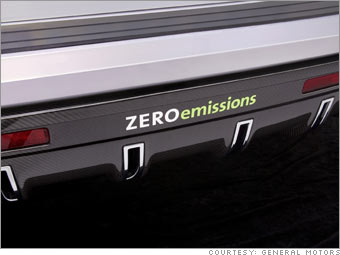
Japanese automakers rev up efforts in hydrogen cars: a car that can be refuelled in minutes but emits only water
It already exists -- Hollywood star Jamie Lee Curtis has one. So does Honda president Takanobu Ito.
Yet while some see them as the ultimate environmentally-friendly automobiles, the high production cost means that affordable hydrogen-powered fuel-cell cars are still more of a dream than reality. Manufacturers such as Honda, however, are making a renewed push behind the vehicles, which run on electricity generated by a reaction between hydrogen and oxygen, belching out nothing more harmful than water vapour.
The big challenge for automakers is to reduce the production cost of hydrogen-powered vehicles - currently several hundred thousand dollars each.
"We believe that the fuel-cell electric vehicle will be the ultimate form for automobiles in the future," Ito said at the Tokyo Motor Show which opened Wednesday. "It has advantages such as zero CO2 emissions in use, can travel considerable distances without refuelling and can be quickly refuelled," he said. Honda last year began delivering about 200 FCX Clarity hydrogen-powered cars on lease to US and Japanese customers, including some Hollywood celebrities.
Toyota, pioneer of hybrids powered by a petrol engine and an electric motor, has said it plans to launch a fuel-cell car by 2015. It is applying its hybrid technology to the vehicles, swapping the petrol engine for a fuel-cell stack."We can't concentrate on just one technology," said Takeshi Uchiyamada, the chief engineer of the first-generation Prius hybrid.
Toyota president Akio Toyoda says he expects that eventually electric cars will be used for short distances and fuel-cell hybrids for long journeys.
Nissan and Mazda have developed their own fuel-cell vehicles and leased them to governments and corporate clients, while Suzuki Motor is showcasing a car, a wheelchair and scooter -- all powered by fuel cells -- at the Tokyo Motor Show.
Read more at: http://www.motoring.co.za/index.php?fArticleId=5217688

Tuesday, September 22, 2009

Harnessing the Energy Beneath Your Tires


Introducing MotionPower™: Harnessing the Energy Beneath Your Tires
One New Jersey Burger King recently equipped its drive-thru with a speed bump that harvests electricity from cars that pass by. The speed bump is part of a pilot project from New Energy Technologies, and if all goes well, drivers could see energy-harvesting speed bumps at drive-thrus, toll plazas and even shopping centres.

The speed bumps, or “MotionPower Energy Harvesters,” look much different from your typical concrete humps. The “bump” is actually flat, with long, skinny pedals running across the top. As cars drive over the speed bump, it pushes the pedals down and turns the gears inside. The spinning creates about 2,000 watts of electricity from a car moving at five miles per hour.

Energy created by the cars is instantaneous (like solar and wind power), meaning that speed bump developers must also figure out a way to store power for later use. To that end, developers at New Energy Technologies are currently experimenting with mini-flywheels (a device that stores energy by spinning), and also plan to look into supercapacitors and other energy-storing mechanisms. Eventually, once storage is perfected, the speed bumps could be used to power street lamps or even feed power directly to the grid.

New Energy Technologies Inc.
is the first public company to develop roadway technology to capture the kinetic energy of vehicles.

Advantages:
• Cost-effective -- easy to manufacture and low operating costs
• Simple and reliable mechanical configuration which is easy to maintain
• Ease of Installation
• Low-profile assembly can be mounted directly atop existing roadways with little or no modifications to roadways
• Modular scalable configuration
• Can be installed in virtually any location

Read more at: http://www.newenergytechnologiesinc.com/

Thursday, August 27, 2009

Tyres with wood


Cheaper, more fuel-efficient tires? Wooden it be good
Oregon State University (OSU) are proposing replacing silica with microcrystalline cellulose derived from plant fiber as a reinforcing filler in the manufacture of rubber tires. The result could be a tire that would cost less, perform better and save on fuel and energy.

As part of their study the OSU researchers replaced up to about 12 percent of the silica used in conventional tire manufacture with microcrystalline cellulose - a micrometer-sized type of crystalline cellulose with an extremely well-organized structure. This decreased the amount of energy needed to compound the rubber composite, improved the heat resistance of the product, and retained tensile strength.

The study also showed that the new tire possessed comparable traction to existing rubber tires in wet, rainy conditions and actually decreased the rolling resistance of the product in high temperatures. This would improve the fuel efficiency of tires made with the new approach in hot weather. Cellulose fiber has been used for some time as reinforcement in some types of rubber and automotive products, such as belts, hoses and insulation – but never in tires, where the preferred fillers are carbon black, which is made from increasingly expensive oil, and silica, which is energy-intensive to process. Both products are also very dense and reduce the fuel efficiency of automobiles. Conversely microcrystalline cellulose is produced in a low-cost acid hydrolysis process.

The research team say that more research is needed to confirm the long-term durability of tires made using microcrystalline cellulose, but hopefully they’ll last longer and provide a smoother ride than these.

Sunday, August 2, 2009

Design a car from scratch

For once- the community decides what goes into the car

Splitwheel is a groundbreaking project to design and build a new performance car based on your input. They are world's first virtual car company and YOU get to decide what sort of car they should build. Combined with entertaining content about cars to inform their decisions, Splitwheel is a revolutionary new experience for enthusiasts. But Splitwheel is not just an online experiment. Their partner, legendary British sportscar manufacturer Caterham Cars, will be turning the designs into reality.
You will be voting on all the key decisions that will shape the design of the vehicle; from styling and engine options to specification, equipment and everything in between!

To understand the concept see: http://www.youtube.com/watch?v=7CGygcEXZI0&feature=player_embedded
See more videos at: http://www.splitwheel.com/Content.asp?ContentID=14

While project splitwheel is currently on hold, another project is underway to build the car for the future.

C,mm,n (pronounced common) is an open community design project that is not only counting on its members to help design a car but is also tasking them with producing a whole new mobility solution to cope with the challenging demands of the future. The blueprints for the proposed electric car concept and the mobility concepts are freely available under an open source licence and contributions are welcome from anyone and everyone. "Generally, any new generation of car builds on existing models. Refinements in design result in a new car that surpasses its predecessor in all aspects: bigger, more powerful, safer and better-looking. C,mm,n abandons this working method completely. The concept of the development of c,mm,n is built around the society of the future, with the needs of the mobilist of 2020 in mind."

Read more on this at: http://www.gizmag.com/cmmn-car-mobility-concept-open-source/12349/?utm_source=Gizmag+Subscribers&utm_campaign=fbb9f0f7e7-UA-2235360-4&utm_medium=email

Wednesday, July 8, 2009

Self-healing body parts for automobiles

Damaged car? It will soon self-heal!

You cut yourself in the finger - and a few days later your skin has completely healed again. Biological organisms have an amazing ability to automatically initiate self-healing and self-repair when they sustain damage. Imagine self-repairing cars, planes, bridges or buildings. These materials could be of particular use in structures that are at present impractical or impossible to repair, such as electronic circuit boards, implanted medical devices or spacecraft. Self-repairing materials would have a massive impact on virtually all industries, lengthening product lifetimes, increasing safety, and lowering product costs by reducing maintenance requirements. Thanks to nanotechnology, these visions are coming closer to reality.

Nickel titanium is a shape memory alloy. The material, if deformed while cool, returns to its undeformed shape when warmed. Other shape-memory alloys (SMA) have since been discovered. Some of these alloys include CuSn, InTi, TiNi, and MnCu. TiNi alloys and copper-based alloys are the most commonly used. It has been found that they can recover substantial amounts of strain, and/or generate significant force, when changing shape.

Smart materials actively respond to the stimulus of mechanical stress imposed on the material, causing the compromised region to self-heal and restore partially or completely, the properties of the material. Applications of self-healing materials span several sectors: composites, building and construction materials, foams, films, coatings, plastics, concrete, etc.
Each individual type of smart material has a different property which can be significantly altered, such as viscosity, volume, and conductivity. The property that can be altered influences what types of applications the smart material can be used for.
Within the next few years a number of cars will possess body parts—such as air dams and handles—made out of shape memory alloys. Self-cleaning glass and scratch-resistant panels will also become the norm. Slightly longer term, self-healing rubber -- such as BASF is developing—will be incorporated into cars.

Watch the smart materials demo at : http://www.youtube.com/watch?v=VU-dChOfkAg
Also in Wikipedia: http://en.wikipedia.org/wiki/Shape_memory_alloys
Read more at : http://corporate.gitverlag.com/media/article/169475/Dow_CMI0509.pdf

Monday, June 29, 2009

Plastic soda bottles- your new car seat cover


Ford Explores 'Suede' Fabrics Made From Pop Bottles, Nanotechnology, and More
Ford Motor Co., which is turning recycling plastic soda bottles into suede-like fabrics for vehicle interiors, is wading deeper into bio-based materials with soy-based rubber fillers and plastics that can biodegrade in 90 to 120 days -- compared to 1,000 years for conventional petroleum-based plastic.

The company introduced soy-based polyurethane foam seat cushions and backs in 2007, and has since included the cushions in more than a million vehicles, with a million more planned this year. The switch has avoided more than 5 million pounds of greenhouse gas emissions.

A soy-foam headliner is destined for the 2010 Escape and Mariner models. Now under development is rubber made with soy protein fillers instead of petroleum-based fillers for door seals, floor mats, gaskets and splash shields.
Other examples of innovative materials in use at Ford include recycled and reassembled ebony wood used in Lincoln vehicles, such as the Navigator.

The resins from used detergent bottles, tires and battery casings are also recycled into underbody systems, including aerodynamic shields, splash shields and radiator deflector shields. All 2009 models in North America will use recycled resin.

The 2010 Fusion and Mercury Milan hybrids will sport seat fabrics made from 100 percent post-industrial recycled yarns, which will reduce energy consumption 64 percent and greenhouse gas emissions by 60 percent.

Twenty used soda bottles make one meter of the faux suede fabric used for the seats of the 2010 Ford Taurus SHO and Lincoln MKZ models.

To read more on what Ford is doing: http://www.ford.com/about-ford/news-announcements/press-releases/press-releases-detail/pr-ford-builds-on-ecofriendly-30398

Reblog this post [with Zemanta]