Wednesday, November 4, 2009

Stop Piracy at the source


IR light from behind the cinema screen prevents pirates from recording films at movie theatres

National Institute of Informatics, Japan in co-operation with Sharp, has developed a technique to render any recording unwatchable by flashing pulses of infra-red (IR) light from behind the cinema screen. The pulses pass through tiny holes in the screen originally designed to allow through sound, and cause interference to any video cameras held by members of the audience. The IR light, while invisible to human eyes, is also impossible to filter out without rendering the recording too blurry to watch. The team says best results are achieved at a speed of 10 pulses per second.

Films screened at cinemas are already digitally watermarked to prevent them from being copied digitally, but there has been no way of reliably stopping pirates from recording films using video cameras. The damage caused by bootleg film recordings is estimated at around 3 billion dollars a year, according to the American Film Institute.

e-Cycler connects people with recyclables but no recycling service, and people who want to collect recyclables for profit.


e-Cycler is a new website that makes the process of collecting - and having collected - recyclables look much more like a part time job than a random act of frugal greenness. It connects people who have recyclables but no recycling service with people who want to collect recyclables for profit.


Both Collectors and Discarders Can Make Money
Two types of people sign up with e-Cycler - those who want to collect recyclables in order to turn a profit, and those who want someone to come pick up their recyclables (and possibly also make a profit). The website connects the two people, and collectors can make either 100% profit from what they collect and take in to centers in exchange for cash, or they can make a 60% profit, giving 40% to the person from whom they collected the recyclables. It's up to the person setting their recyclables out whether or not they want to simply give them away, or gain some extra pocket change themselves.

And e-Cycler Wants Money Too
e-Cycler wants to turn their own profit, so they are initializing a small fee on the collector for each lead they receive from the site on who they can go collect from. Even if you as a collector are paying a fee to e-Cycler and giving 40% to the discarder, if you're hard up for some extra income and/or have a passion for seeing recyclables actually get recycled, the cut in profit may still be made up for in the saved time of going straight for a batch of recyclables rather than randomly scouring gutters and trash bins during daily walks.

What's the Impact of All These Collectors?
While this is a great system to help get recyclables to recycling facilities in areas where there isn't curbside pickup provided by the city, we are still curious about the impact of having people most likely driving around in cars and pickup trucks collecting the recyclables and driving to centers to turn them in. Maybe there could be an option for reduced fees for collectors who use bicycles with carts rather than cars. No matter what, e-Cycler seems like a better option than having no curbside recycling at all, and likely a smaller impact than city garbage trucks grumbling down the roads.

Check out the website: http://ecycler.com/

New technology to clean cabin air during flights


AirManager cleans cabin air

The global spread of viruses such as swine flu could be slowed by new air-sanitation technology on aircraft, claimed its UK developers.

The AirManager technology from Cheshire-based Quest International UK has completed trials with five European airlines. The units are now being prepared for installation across one European airline's entire fleet of Avro RJ aircraft. AirManager, which is being distributed internationally by BAE Systems, works using a patented non-thermal plasma technique known as CCFT (Close-Coupled Field Technology).

Inventor David Hallam, director of Quest International, explained a high-voltage coil in a dielectric arrangement generates the contained electrical field. This field destabilises compounds and materials in the air passing through it. A combination of high-voltage forces and oxidative stress within the field attacks inorganic and organic compounds at the molecular level and effectively strips them down to their component elements. Any inert particulate materials are then passed through a 3M-manufactured High Air Flow (HAF) filter, which has an electrostatic surface area designed to attract, capture and retain particles down to 0.1 micron in size. The air is cycled 30 times before it is released into the cabin area.

Hallam said AirManager can remove up to 99.999 per cent of all pathogens in a single pass and an even greater amount of airborne viruses can be destroyed in the same amount of time. A unit is also claimed to be able to eliminate volatile organic compounds and offensive cabin smells from the air. He added: 'It is important to show you are doing everything in your power to stop transmission on board. Swine flu is one pandemic; there will be others, and with international travel these things spread a lot faster than they would have historically. So anything that can cut down on that has got to be a good thing.'

Read the full article at: http://www.theengineer.co.uk/Articles/Article.aspx?liArticleID=313201

Bed that turns into wheelchair


Panasonic develops bed that turns into wheelchair
The invention is designed to help people with limited mobility maintain an independent lifestyle, the firm said in a statement. "Now, the user can join the family meal by converting the bed into a wheelchair and moving to the dining table without the need of assistance from other people," it said. Panasonic will exhibit the Robotic Bed at a home care and rehabilitation exhibition in Tokyo from September 29 to October 1, it said.
"It is still a concept model and we will not be selling it soon," said Panasonic spokeswoman Yuka Arii. "We plan to bring it to markets in or after 2015. But we don't know the price yet." Japan has one of the world's oldest populations and faces a constant shortage of care workers.
Read more at: http://www.japancorp.net/Article.Asp?Art_ID=22017

Filming photons, one million times a second


Filming photons, one million times a second
European researchers have created a CMOS (semiconductor) camera capable of filming individual photons one million times a second. The breakthrough will impact on all the most advanced areas of science and makes Europe the world leader in the technology.

The scientists wanted to create the fastest, highest resolution CMOS (semiconductor) video camera, but to do that they needed to choose an ultra-fast photo detector. They also needed to choose between two competing timing mechanisms or stopwatches, Time to Analogue Convertors (TAC) and Time to Digital Convertors (TDC).

The timing mechanism is important. It can tell, to within a few tens of picoseconds, when the photon arrives at the detector. It creates stunning resolution in time.

Imaging technology has advanced rapidly over the last few years. But the demands of science have advanced even more rapidly. New scientific fields like proteomics - studying the different proteins that form the human body - pose a problem because they require cameras that are capable of recording data at photon-resolution, and extremely fast. That problem is now essentially solved thanks to the work of the Megaframe project, which developed a CMOS video camera that can capture 1024 individual photons at one million frames a second. It can record, to within 100 picoseconds, when the photon arrived at each detector. It is insanely fast.
Must Read more: http://www.physorg.com/news173957578.html

Thursday, October 8, 2009

FON

You pay for internet access at home, so why must you pay for it again at the coffee shop, the airport and the hotel? That frustration spawned Spanish Wi-Fi startup Fon. It's a simple idea: Give and you shall receive. "Foneros" first agree to share their home wireless connections with other Fon customers using a special router, which splits the signal into public and private streams. In exchange, they get the privilege of using any of the network's wireless signals anywhere in the world for free. Fon has inked important deals with TimeWarner Cable in the United States, BT in Britain and Neuf in France, and its network has expanded to an impressive 600,000 registered users worldwide. Free global internet for the price you already pay at home?

FON is the world’s largest WiFi community and the best way to get connected to the internet for free!
When you buy any Fonera (FON’s line of revolutionary WiFi routers) and connect it to your existing broadband connection, you create a FON Spot (a secure WiFi access point) that allows you to share your WiFi connection with other FON members.

The Fonera 2.0 series allows you to do even more with your WiFi. You can upload videos to YouTube, and photos to Facebook, Picasa or Flickr and download torrents or files, directly to or from an external hard disk...even when your computer is off!

* Founder: Martin Varsavsky
* Funding: Approx. $35 million from Skype, Google, Index Ventures, Sequoia Capital, Excite, Digital Garage and BT
* Employees: Approximately 90 worldwide

Check out their website: http://www.fon.com/en/
For a quick tour: http://www.youtube.com/watch?v=NlhaNaFc89U&feature=player_embedded#at=41

Filming photons, one million times a second


Filming photons, one million times a second

European researchers have created a CMOS (semiconductor) camera capable of filming individual photons one million times a second. The breakthrough will impact on all the most advanced areas of science and makes Europe the world leader in the technology.

The scientists wanted to create the fastest, highest resolution CMOS (semiconductor) video camera, but to do that they needed to choose an ultra-fast photo detector. They also needed to choose between two competing timing mechanisms or stopwatches, Time to Analogue Convertors (TAC) and Time to Digital Convertors (TDC).

The timing mechanism is important. It can tell, to within a few tens of picoseconds, when the photon arrives at the detector. It creates stunning resolution in time.

Imaging technology has advanced rapidly over the last few years. But the demands of science have advanced even more rapidly. New scientific fields like proteomics - studying the different proteins that form the human body - pose a problem because they require cameras that are capable of recording data at photon-resolution, and extremely fast. That problem is now essentially solved thanks to the work of the Megaframe project, which developed a CMOS video camera that can capture 1024 individual photons at one million frames a second. It can record, to within 100 picoseconds, when the photon arrived at each detector. It is insanely fast.

Must Read more: http://www.physorg.com/news173957578.html

Monday, October 5, 2009

Holograms That Respond To Touch


Holograms That Respond To Touch
Japanese scientists have developed a technology that allows holograms to respond to human touch.

Using ultrasonic waves and Nintendo Wii controllers, scientists created a software program that tracks the movements of a person's hand and allows holograms to respond to the "touch" of a hand. By using ultrasonic waves, the scientists have developed software that creates pressure when a user's hand "touches" a hologram that is projected. In order to track a user's hand, the researchers use control sticks from Nintendo's popular Wii gaming system that are mounted above the hologram display area.

Possible uses include holographic controls on hospital machines that could replace easily contaminated physical controls.

Read more at: http://www.reuters.com/article/lifestyleMolt/idUSTRE58F1KP20090916

Become a human antenna with your own carpet radio


Become a human antenna with your own carpet radio

When I was young I had a tall, wiry friend we nicknamed ‘the Human Antenna’. Now anyone, regardless of height, can rival my friend just by walking on a unique carpet recently created by Swiss designer Florian Kräutli. The carpet appears to be a typical modern rug and would look at home in most abodes, except that is has one unusual hi-tech feature - this white carpet is also a radio.

The carpet is constructed of looms from conductive thread and capable of transforming into an antenna. The carpet picks up the radio waves which the body receives, and makes them audible. To change a radio frequency you just walk on a carpet or sit or stand in a different position. The video below shows the range of signals the carpet attracts - from soft static to louder static - so I’m not sure the concept is ready for the mass market just yet, but the potential is there.

In the meantime, the carpet could be useful as a good variation on the popular ‘Twister’ game – first one to contort into a position that attracts a recognizable radio station wins. Hours of fun for the entire family or a few drunken friends? I’m not sure Kräutli had this in mind when he designed the floor covering.

But for those who like to entertain, it’s a great way of ensuring your house has the potential to deliver wall-to-wall sound.

See the video at: http://vimeo.com/5334661
Information source: http://www.gizmag.com/human-antenna-carpet-radio/13015/?utm_source=Gizmag+Subscribers&utm_campaign=3a99ce2838-UA-2235360-4&utm_medium=email

Reblog this post [with Zemanta]

Solar panel which looks like roof tile


Not your average solar panel: The SRS solar roof tile
Thanks to a system created by SRS Energy and offered exclusively as an upgrade option to customers of US Tile (the largest manufacturer of clay tile in the United States), those wishing to benefit from rooftop solar energy will no longer have to worry about any panels being stuck on the side of the roof and spoiling the aesthetics. The Solé Power Tile system is the first building-integrated photovoltaic roofing product designed to blend in with curved roof tiles commonly found in the Pacific West and Southwest of the United States.

According to SRS Energy: "triple-junction amorphous silicon thin-film technology incorporated within the Solé Power Tile" is manufactured by United Solar Ovonic and "allows the system to produce an estimated 8-20% more energy than incumbent crystalline silicon panels of the same rated power."

Any power generated by the system which is not used by the building (or stored in batteries if that option is chosen) is fed into the grid. Utility companies then give a credit for the amount of energy generated meaning financial benefits can be enjoyed from day one. Each system is monitored to provide feedback so that checks can be made against any credits made.

Details and installation photographs can be viewed on both SRS's website and US Tile's website.

Read more at: http://www.gizmag.com/srs-curved-solar-roof-tiles/12584/

Emergency light works on telephone line

Telephonic Emergency Light
This is a unique light which does not require any power supply or does not need any charging. It works on your normal landline telephone connection. Just keep this light plugged in to you phone line. Whenever there is a power failure, just press the ON button. The light will instantly light up giving you enough light in your room or office.

• This is a powerless Emergency Light which draws power from telephone line.
• ZERO COST Operation: No electricity bill, No batteries, No fuel, simply plug in your phone line and enjoy unlimited lighting. ( No phone bill also)
• 21 Super bright white LED lights which does not need replacement as their life is 1,00,000 hours.
• Indoor & Outdoor use: For outdoor use, there is an optional power source wherein you can insert 3AAA size batteries and use it without the phone line also.
• City Usage: In cities, where are no frequent power cuts, people usually does not charge emergency lights and keep daily. They also do not have fully charged torches or lamps. But if suddenly power goes off, this light can be very useful as phone lines still works.
• Village Usage: In towns where there are frequent power cuts, this light can be used on zero cost operation.
• Slim design can be mounted on wall or can be kept on table.
• Can be easily carried while traveling.

Check the link: http://www.shoponlineindia.net/pages/tlamp/

Monkeys cured of colour blindness- next target humans


Scientists cure colour blindness in monkeys - humans next?
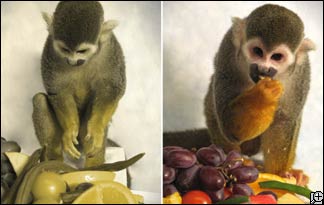
Researchers have delivered promising results by successfully treating two squirrel monkeys with defective colour perception using a gene therapy that could also safely eradicate colour blindness in humans. Millions of people around the world, including 3.5 million Americans, 13 million people in India and 16 million in China, are affected by colour blindness. It is a congenital problem, largely experienced by men, that renders its sufferers incapable of discerning mainly red and green hues: seemingly trivial but, in reality, a necessity for everyday practicalities such as recognizing traffic lights.

According to Jay Neitz, professor of ophthalmology at the University of Washington, “Nothing happened for the first 20 weeks…but we knew right away when it began to work. It was as if they woke up and saw these new colours. The treated animals unquestionably responded to colours that had (previously) been invisible to them.” It has taken more than 18 months of testing the monkeys' ability to discern 16 hues, with some varying as much as 11-fold in intensity. The monkeys were able to trace colour patterns on a computer touch screen and, when they chose correctly, they were rewarded with grape juice.

Read more at: http://www.gizmag.com/scientists-cure-color-blindness-in-monkeys/12881/?utm_source=Gizmag+Subscribers&utm_campaign=2f43e924c1-UA-2235360-4&utm_medium=email

Braille Label maker developed by students


Students design portable Braille label maker
Karina Pikhart ’09 displays the braille labelmaker she and her teammates designed, starting last year as a project in the Product Engineering Processes class (2.009). Photo - Patrick Gillooly;

One everyday problem for people who are blind or have very limited sight is distinguishing things that are completely identical to the sense of touch, such as different CDs and DVDs, or canned goods that are all the same size and shape. To cope with that difficulty, many people make Braille labels to attach to these items.

But the existing devices for doing this are either expensive and heavy — one costs about $650 and has limited portability — or light and inexpensive but very difficult for a blind person to operate, and limited in the number of characters they can imprint.

A team of MIT students in last fall's Product Engineering Processes (2.009) class searched for a better way. They came up with a prototype device that is small and easily portable, can produce the entire panoply of possible Braille characters (including commonly used two-character contractions), and can be relatively easily loaded and operated by touch. Although it is still under development, they hope the device, which they have named the 6dot Braille Labeler, can ultimately be produced for sale at around $200.

Some of the students continued to refine the product after the class ended, producing an improved version that won a $7,500 prize in the spring IDEAS competition (a joint project of the MIT Public Service Centre and the Edgerton Centre that recognizes innovations that benefit communities worldwide). Eight students from the mechanical engineering department, some who graduated in June and others who are still enrolled, joined by two others, are in the process of forming a company to continue development of the labeller. Over the summer they conducted field tests around the country with 25 potential users of the product, giving each about a half-hour to work with the device.

"Blind people really wanted to see this product on the market," says Karina Pikhart '09, who is CEO of the new company. "We worked really closely with blind people" in developing it, she says, because "you really can't develop a product without being in close touch with the people you're developing it for. They gave us a lot of good feedback." One of the comments they received was that the clear quality of the Braille produced by the device "felt like what really neat handwriting must look like," she says.
Read more at: http://web.mit.edu/press/2009/braille-0821.html

New vest protects from an avalanche


Avalanche Safety System

The AvaJacket is a safety vest to help skiers survive an avalanche. It features airbags that open up to restrain the head from being twisted into dangerous positions, and a breathing system that aims to separate exhaled air from the much needed oxygen rich variety.

"The device works by extracting the mouthpiece from its pocket: in just a few seconds, the airbag located in the collar is inflated around the neck of the victim, protecting a vital part of the body and decreasing the burial depth. Once submerged by the snow, the airbag slowly deflates; with its volume, around which the snow has become thick and solid, it has gained space around the victim's neck and kept the airways clear, besides having given more chances to the victim's motion and wiggle. Meanwhile, it is possible to breathe through the mouthpiece which separates the inhaled air from the exhaled air."

See the video : http://www.youtube.com/watch?v=ZynCfMFow9Q&feature=player_embedded

Virtually waterless laundry cleaning


"virtually waterless" laundry cleaning:

Now a new process is becoming available that can use as little as a cup of water and use a different sort of detergent. The next generation Eco friendly washing machine which could reduce the water usage by 90 %, this technology is developed by researchers at Leeds University, which is home to one of the UK’s most advanced textile institutes, they have established a company called Xeros Ltd to marked this laundry cleaning technology.

This technology cleans clothes using reusable nylon polymer beads with an inherent polarity that attracts stains. According to them the tiny nylon polymer beads are designed to gently but fully penetrate into a large wash load. Only a small amount of water is required to dampen the garments, loosen stains and create the water vapor that activates the “molecular magic” of the beads. The beads are then tumbled with the clothes, allowing the polarizing properties of polymer to attract and absorb dirt. Once diffused into the bead itself, stains are locked away from the garment, preventing redeposition, after washing completes this beads are automatically removed by the machine, this beads could last for about 100 loads adequate for the six months of average family usage.

Company plans to launch this laundry cleaning technology by 2010

Read more at: http://inspiredeconomist.com/2009/06/26/virtually-waterless-laundry-washing-machine/