Showing posts with label social. Show all posts

Wednesday, May 27, 2009

Cell Phone for Blind people

CELL PHONE FOR THE BLIND AND FOR INDIVIDUALS WITH LEARNING DISABILITIES

Blind users hear the contents of the document read in clear synthetic speech, while users who can see the screen and those with learning disabilities can enlarge, read, track, and highlight printed materials using the phone's large and easy-to-read display. The combination of text-to-speech and tracking features makes interpreting text much easier for individuals with learning disabilities.

K -NFB Reading Technology, a company combining the research and development efforts of the National Federation of the Blind and Kurzweil Technologies, unveils an exciting product line that will revolutionize access to print for anyone who has difficulty seeing or reading print, including the blind and learning disabled. The company’s world-renowned reading software has been especially designed for and paired with the Nokia N82 mobile phone to create the smallest text-to-speech reading device in history.

Cell phone and Reader combination
Blind users will have access to all of the functions featured in the most advanced cell phones on the market including video and music playback, GPS, wireless communications, photography, e-mail, text messaging, calendar and task functions, and more. The combination Reader and cell phone weighs 4.2 ounces and can store thousands of printed pages with easily obtainable extra memory. Users can transfer files to computers or Braille notetakers in seconds.

knfbREADER Mobile with a user friendly interface
"The knfbREADER Mobile allows me immediate access to printed information, whether it be a menu or a letter," said James Gashel, vice president of business development for K-NFB Reading Technology, Inc. and a blind user of the product. "So many people already carry cell phones. This innovation is exciting because it puts all of the functions that users need into one product, eliminating the need to carry multiple devices. The Reader's simple user interface makes it ideal for the growing number of blind seniors."

Cell phone for disabled people
"Technology that enlarges the printed word or converts it to speech has dramatically improved the lives of millions of Americans with many types of disabilities, enabling them to read and comprehend printed materials to which they never before had access," said Ray Kurzweil, President and CEO of K-NFB Reading Technology, Inc. "This innovation has created opportunities disabled people had never considered before due to the large amounts of reading required in certain occupations. The first machine of this type was the size of a washing machine. As optical character recognition technology is integrated into smaller and smaller devices, access to print becomes available almost instantaneously."

Reblog this post [with Zemanta]

Monday, May 25, 2009

Make your own spectacles


Inventor designs 'tunable' glasses to help one billion in Third World see
The need: The U.K Guardian reports that there is one optometrist for every 4,500 people in Britain, while in sub-Saharan Africa the ratio is 1:1,000,000.
The Innovator: Joshua Silver who was a professor at Oxford University,
The innovation: His adaptive glasses are designed to be "tuned" by the wearer to suit their eyes without the need for a prescription and can help both short-sighted and long-sighted people. Working on the principle that thicker lenses are more powerful than thin ones, Prof Silver's spectacles can be adjusted by injecting tiny quantities of fluid. The tough plastic glasses have thin sacs of silicone liquid in the centre of each lens. They come with small syringes attached to each arm with a dial for the wearer to adjust the amount of light-bending silicon until they can see clearly. Once the lenses have been adjusted, the syringes are removed and the spectacles worn just like a prescription pair. They are similar to wearing double paned windows with a gel in between. The current price is a pretty cheap $19.

The journey: He set on the idea of developing an adjustable spectacle after a chance conversation in 1985 when he and a colleague were discussing optical lenses. It took more than 20 years to finally come up a design which can be made cheaply on a large scale. Today, his invention is being worn in more than 10 countries, including African villages. Soon, the poor of India also will be sporting Silver’s spectacles.
Along his journey to delivering a viable product, Silver won a Popular Science Best of What’s New Award in 2000. His AdSpecs were featured again in the magazine’s March 2009 issue. He has steadfastly followed an arduous journey, and refuses to sell his idea for monetary gain. No IPO in this man’s future, although he said he has been offered millions for his design. He is afraid that another company wouldn’t make the world’s poor their priority. So, he looks for philanthropists who are interested in ministering to the disadvantaged. He was recently joined by an Indian businessman, and together they plan to provide one million pairs of glasses in India.

The Future: Professionals devoted to eyesight problems are few and far between in developing countries. Silver hopes to deliver self-adjusting eyeglasses to 1,000,000 underserved Indian people.
Money is a factor, of course. Silver is aiming to distribute 100 million pairs each year. Getting the production costs down to a dollar a pair is more than a challenge, even in lots of a million at a time. Oxford University has agreed to host a Centre for Vision in the Developing World, with plans to work on a World Bank-funded project. Hopefully, that will attract more funds for Silver’s humanitarian cause.

You tube video: http://www.youtube.com/watch?v=W4OiRjv81BY
Here’s a link to the story: http://www.telegraph.co.uk/health/healthnews/3899781/Inventor-designs-tunable-glasses-to-help-one-billion-in-Third-World-see.html

Thursday, May 7, 2009

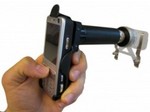
Device Turns A Cellphone Into A Microscope


“Say you're in a remote or undeveloped part of the world, and you have to diagnose an illness. Even if you could find a microscope, you don't have a doctor to look through it, but you do have a cell phone. What if you could attach the phone to the microscope, call another cell phone halfway around the world, and have the doctor with this phone see what the microscope sees? That's the idea behind CellScope.”
The new CellScope turns a standard camera cell phone into a microscope of clinical quality with a magnification of up to 50X. This proves to be of great value for the health workers in the developing countries, where there is scarcity of proper equipments due to heavy cost or physicians. In such places and conditions the CellScope plays a vital role as the health workers can easily capture necessary images of blood cells and infections and then transmit through the cell phone network to the experts for further analysis.

The CellScope, developed by the research scholars of University of California at Berkeley is not just a fun device but has the potential to save lives even. Just by clipping the device to your camera cell phone, PDA or netbook, you can easily collect and organize data of patients. The organized data can then be sent wirelessly to the remote experts and receive instant response as well. The CellScope can be clipped easily to the cell phone with the help of a modified belt clip. A set of high brightness white LEDs are responsible for providing the illumination. These LEDs draws their power from the battery attached to the device. The CellScope can be angled so as to illuminate any sample fully at its focal point.
The team believes that if mass produced, the device could be sold for around $50, an incredible price for a clinical quality microscope that can send diagnostic data all over the world.

The CellScope has been awarded with a cash prize of $100,000 in the Intel INSPIRE EMPOWER Challenge and was also a winner of Vodafone Americas Foundation Wireless Innovation Project. But this is not the end as research team is constantly testing the device rigorously so as to come up with some advance version of it. The cash prize would be used in the improvement of the device, as planned by the research team members.

You tube video: http://www.youtube.com/watch?v=J_44YIAGpf4

Thursday, April 16, 2009

Solve 2.5 lac pending cases in 2 days!

MEGA LOK ADALAT
Initiated by Justice T. S. Thakur, Chief Justice of Punjab and Haryana High Court, this innovation aims to settle maximum number of cases through mutual consensus without following the lengthy judicial process. A two-day Mega Lok Adalat was organized to decrease the huge pendency of cases in the Subordinate Courts, as per the directions of Punjab and Haryana High Court Chief Justice T S Thakur. Done on December 20 and 21, 2008.

The journey to make this experiment a smash hit started some three months before with high court authorities informing their subordinate courts that they would try and clear 2.5 lakh cases in 2 days. They were told to collaborate with various government departments and corporates and set a cut-off limit regarding value. Hence all cases below this amount were given a chance to be heard at the mega lok adalat. Arrangements were made for security to be provided by cops and medical facilities were arranged from the administration, which made it an `event to remember' on Saturday.

Impact:
In Chandigarh: more than 30,000 cases under various Acts were settled on Day One, with transaction of almost Rs 4 crore taking place in Chandigarh's district courts.
In Punjab’s Hoshiarpur district, an area known for people taking every small matter to court, over 14,000 cases were disposed off in one day itself
In Ludhiana district alone, 56 Judicial Benches were set up during the Mega Lok Adalat and more than 44000 cases were disposed off involving a compensation of around 37.71 crore.
Haryana, Financial Commissioner& Principal Secretary (Power), Ashok Lavasa said here today that the distribution corporations had offered an attractive settlement scheme for all type of cases pending in various courts, to settle through Mega Lok Adalats by paying 50 per cent of the penalty in most of the cases. Surcharge levied on the arrears in such cases was to be waived off 100 per cent. Responding to the attractive scheme, as many as 3240 consumers came forward to get their cases settled in Mega Lok Adalats through mutual consent. An amount of Rs 1402 crore was involved in these cases out of which Rs. 405 crore have been recovered through settlement.
A ‘mega’ Lok Adalat for settlement of the Motor Vehicle Act cases pending in the High Court, district courts of Hyderabad and Ranga Reddy besides tribunals will be organised here on February 15, 2009 in Andhra Pradesh.

Wednesday, March 4, 2009

Switch on the pumpset with your mobile

NANO GANESH

The device called as 'Nano Ganesh' helps a farmer to switch on/off the pump-set through a call made by a mobile or a land line phone or even a PCO phone from anywhere in the world.
It will be priced between Rs.560 and Rs.1700 was commercially launched on 23rd September 08 in Pune.

Santosh Hiralal Ostwal, established a research and development center to develop the product in Pune in 1996. He developed a mobile modem, which controls the starter of the pump set. The modem along with a mobile phone, which interfaces a 440 volt system, is attached to the starter panel of the pump-set. On the deployment of the system, a pre-set code is given to the farmer to switch on/off the pump-set. In order to switch on the set a farmer has to call up the number of the mobile phone attached in the starter panel. One can confirm the availability of the power in the pump-set by a long beep sound, which will be signalled from the receiving end during the call Followed by the confirmation of availability of the power, the caller has to dial a preset code provided for the user to switch on the pump set. Once the code is dialled the user has to confirm his function by a feedback tone and then cut the call. For switching off the pump-set, the same process has to be repeated and a different preset code is entered to switch off the pump-set.

To make the phones easily accessible to the farmer community, Santosh deployed basic phones like Nokia 1100. To ease the system of deployment, the company provides the buyer with a CD, an instruction manual and a wiring diagram along with the product explaining in a step by step way to fit and use 'Nano Ganesh'. The modem is also available with a theft proof inbuilt device called 'Nano Ganesh Hanuman', whereby its installation will also ensure alert in case of theft attempt near the pump area related to pump-set cable, panel or pump itself.


See the video here: http://www.youtube.com/watch?v=ZeZ4jzV8VVY

Friday, February 27, 2009

India's 1st P2P lending platform: dhana X

dhanaX is an online-offline person-to-person (P2P) lending platform that allows Indians to lend and borrow money from each other.

How it works?: dhanaX identifies and partners with recognized microfinance organizations, NGOs and credit societies that look into the economic needs of the poor . As a lender, you can extend credit at a mutually agreed rate of interest to a suitable enterprise or individual through dhanaX . At the end of the stipulated loan period, dhanaX will facilitate the repayment of principal amount with interest with the help of partner organizations

DhanaX gets a 6 per cent commission from a borrower on every funded loan, and takes a 1.5 per cent service fee on monthly repayments from a lender. So effectively, DhanaX earns 7.5 per cent on every transaction. There is also a registration Fee to enter into the system

First to introduce the concept of social lending. For a lender looking for a social investment, or a borrower seeking an affordable loan, dhanaX is the best forum – It connects them. Interest rates are co-created. Facilitators of the process, legally compliant. Assures collection guarantee

It is the first Indian company to come up with the concept of P2P lending and make a business model out of it. Has created a new ecosystem by partnering with MFI, NGO to bridge the need gap among economy classes. Lender gets an interest rate better than a short-term fixed deposit. Borrowers get loans on affordable interest rates. Business Process is being patented

http://www.dhanax.com

Tuesday, February 24, 2009

EDUSAT: World's first education satellite Launched by ISRO

On sep 20, 2004 the Govt. of India launched a dedicated Satellite called EDUSAT (Educational Satellite) to serve the educational sectors, offering an interactive satellite based distance education system for the country. In Karnataka State the EDUSAT is being used to supplement classroom teaching in all the elementary schools (850 Schools) of one district .

Satellites can establish the connectivity between urban educational institutions with adequate infrastructure imparting quality education and the large number of rural and semi-urban educational institutions that lack the necessary infrastructure. Besides supporting formal education, a satellite system can facilitate the dissemination of knowledge to the rural and remote population about important aspects like health, hygiene and personality development and allow professionals to update their knowledge base as well. Thus, in spite of limited trained and skilled teachers, the aspirations of the growing student population at all levels can be met through the concept of tele-education

EDUSAT is the first exclusive satellite for serving the educational sector. It is specially configured for audio-visual medium, employing digital interactive classroom and multimedia multicentric system. In the first phase of pilot projects, a Ku-band transponder on board INSAT-3B, which is already in orbit, is being used. In this phase, Visveswaraiah Technological University (VTU) in Karnataka, Y B Chavan State Open University in Maharashtra and the Rajiv Gandhi Technical University in Madhya Pradesh are covered. In the second phase, EDUSAT spacecraft, once commissioned in orbit, will be used in a semi-operational mode with at least one uplink in each of the five spot beams. About 100-200 classrooms will be connected in each beam. Coverage will be extended to two more states and one national institution. In the third phase, EDUSAT network is expected to become fully operational. ISRO will provide technical and managerial support in the replication of EDUSAT ground systems to manufacturers and service providers. End users are expected to provide funds for this. In this phase, ground infrastructure to meet the country’s educational needs will be built and during this period, EDUSAT will be able to support about 25 to 30 uplinks and about 5000 remote terminals per uplink.

Complete details are available here: http://www.isro.org/Edusat/Page2.htm

Tuesday, February 17, 2009

DAKNET: villages connected through WiFi

Context: The Karnataka state government in India has computerised land records. The only problem is that the servers storing these records are in district headquarters and are not easily accessible to villages that, while perhaps only 70 kms away, are without phone lines. WiFi is the currently the best wireless technology available. It is easy to set up, use and maintain with high bandwidth and is a low-cost solution for both the providers as well as users. Rural ICT’s are typically introduced as communications channel shared across the community which rely on land-line, telephone or satellite radio links. The service was developed by First Mile Solutions, based in USA.

Innovation: FMS in collaboration with the Government of Karnataka started the world’s first DakNet Enabled bus. The primary DakNet pilot in India was with Bhoomi, an eGovernance initiative established by the Indian State Government of Karnataka to computerize all land records in Karnataka.

How the service operates: United Villages has installed Mobile Access Points (MAPs) on existing vehicles such as buses and motorcycles which ply in rural areas. There are kiosks which have been installed in villages, which typically have a computer with a real-time wireless internet connection. United Villages sells pre-paid cards to village kiosk operators who in turn resell them to the villagers, who can use it to avail services such as sending e-mails, voicemails, SMSs, purchase railway tickets online, access matrimonial sites, job search sites etc. Whenever an MAP is within the range of the wireless network, it picks up the stored data from the kiosk computer and forwards it to the internet in cities.

Download and watch the new United Villages India video! (107MB, Windows Media Video)