Showing posts with label Solar. Show all posts

Monday, October 25, 2010

Balloon Shaped Solar Collector

Balloon Is Solar Collector: Solar Technology to Power the Planet

Cool Earth Solar has developed a breakthrough solar technology that can ultimately produce enough clean energy to address the global energy crisis. This technology dramatically reduces the cost and time to develop power plants capable of generating massive amounts of clean, inexpensive energy. They’ve designed a breakthrough solar technology based on a two-pronged design philosophy:

* Use a minimum amount of materials

* Use materials that are inexpensive and abundant

CoolEarth has created an innovative way to harness the sun's energy. Instead of large expensive solar panels or costly concentrating mirrors, the company is using balloons made of metalized plastic films. Half of the balloon is transparent, letting the light in to be concentrated into a small high-efficiency solar panel by the concave interior. Each is 2 meters across and, depending on the source, estimates vary from 500 watt to 1 kilowatt. They are supported by cables, leaving the ground below clear and limiting environmental impact.

Read more at: http://www.coolearthsolar.com/technology

tiny glitter-sized photovoltaic cells that could revolutionize the way solar energy is collected and used

Glitter-sized solar photovoltaics produce competitive results

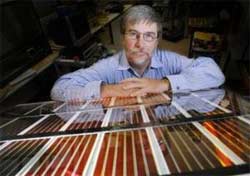
From 14 to 20 micrometers thick (a human hair is approximately 70 micrometers thick), they are 10 times thinner than conventional 6-inch-by-6-inch brick-sized cells, yet perform at about the same efficiency.

The tiny cells could turn a person into a walking solar battery charger if they were fastened to flexible substrates molded around unusual shapes, such as clothing.

The solar particles, fabricated of crystalline silicon, hold the potential for a variety of new applications. They are expected eventually to be less expensive and have greater efficiencies than current photovoltaic collectors that are pieced together with 6-inch- square solar wafers.

The cells are fabricated using microelectronic and microelectromechanical systems (MEMS) techniques common to today's electronic foundries.

Sandia lead investigator Greg Nielson said the research team has identified more than 20 benefits of scale for its microphotovoltaic cells. These include new applications, improved performance, potential for reduced costs and higher efficiencies.

"Eventually units could be mass-produced and wrapped around unusual shapes for building-integrated solar, tents and maybe even clothing," he said. This would make it possible for hunters, hikers or military personnel in the field to recharge batteries for phones, cameras and other electronic devices as they walk or rest.

Even better, such microengineered panels could have circuits imprinted that would help perform other functions customarily left to large-scale construction with its attendant need for field construction design and permits.

Read more at: http://www.physorg.com/news180713660.html

Wednesday, November 11, 2009

World's First solar-powered Flight


Pioneering Swiss solar-powered plane rolled out
An aircraft dubbed 'Solar Impulse', HB-SIA prototype, is rolled out of a hangar for an initial series of stationary tests involving engines and electromagnetic interference in Duebendorf aerodrome near Zurich.
All four sun-fuelled electric motors were switched on for the first time under open skies after the completed high-tech plane was pushed out of the hangar. "With its engines running at full power, it gave the impression of wanting to get off the ground straightaway... but it won't be long now before we release the brakes and let it roll its first few metres," said Andre Borschberg, co-founder and chief executive of Solar Impulse.

The ultralight single seater with the wingspan of an Airbus A380 airliner is being prepared for a maiden flight over the coming weeks when weather conditions allow. Solar Impulse staff said the slender craft, which only weighs as much as a medium-sized car (1,600 kilogrammes, 3,527 pounds), needs particularly clear conditions and less than a light breeze (three knots) for its first excursion in the air. It is due to make a few airborne hops down the runway at the Dubendorf airbase before December 20.

Borschberg said the aircraft was venturing into new flying territory. "Compared to its weight and size, it is lighter than the best performing gliders," he explained.

The prototype, which is slightly smaller than the craft that is expected to fly around the world, was first unveiled while it was being built in its hangar in June. It is primarily aimed at testing the cutting edge technology used to build and control the aircraft, and to fly through the night.

A first non-stop 36 hour flight through darkness is planned in Switzerland from spring 2010, with the prospect of a five stage flight around the world in 2012.

Color-changing roof tiles


Color-changing roof tiles absorb heat in winter, reflect it in summer

A team of recent MIT graduates has developed roof tiles that change color based on the temperature. The tiles become white when it's hot, allowing them to reflect away most of the sun's heat. When it's cold they turn black and absorb heat just when it's needed.

The team's lab measurements show that in their white state, the tiles reflect about 80 percent of the sunlight falling on them, while when black they reflect only about 30 percent. That means in their white state, they could save as much as 20 percent of present cooling costs, according to recent studies. Savings from the black state in winter have yet to be quantified.

The team, which the students call Thermeleon (rhymes with chameleon, because of its color-changing property), was one of the competitors in this year's Making and Designing Materials Engineering Contest (MADMEC). Nick Orf PhD ’09, a member of the Thermeleon team, explains that he and his teammates originally tried to develop a color-shifting roof tile using a system of mixed fluids, one dark and one light, whose density would change with temperature: the dark substance would float to the top when it was cold, and white would float when it was hot. But the system proved too complicated, and instead they hit on a simpler, less expensive method.
Now, they use a common commercial polymer (in one version, one that is commonly used in hair gels) in a water solution. That solution is encapsulated — between layers of glass and plastic in their original prototype, and between flexible plastic layers in their latest version — with a dark layer at the back.

When the temperature is below a certain level (which they can choose by varying the exact formulation), the polymer stays dissolved, and the black backing shows through, absorbing the sun's heat. But when the temperature climbs, the polymer condenses to form tiny droplets, whose small sizes scatter light and thus produce a white surface, reflecting the sun's heat.
Read more at: http://www.physorg.com/news174209373.html

Wednesday, November 4, 2009

Solar IVY


Solar Ivy: Introducing GROW: a new approach to solar and wind power
GROW is a hybrid energy delivery device that provides power via the sun and wind, and draws inspiration from ivy growing on a building.

Solar Ivy utilizes a structural stainless steel mesh system, which is manufactured by Carl Stahl Decorcable in Germany. Their system is designed to enable plants (such as ivy and other crawlers) to grow up the sides of buildings without causing damage to the building's exteriors, a typical problem of many vertical gardens.

These leaves are made of 100% recyclable polyethylene, and are available in a variety of colors and opacities. The solar cells are thin film flexible photovoltaic modules encapsulated in Tefzel, and are manufactured by PowerFilm Solar. Solar Ivy is a flexible system that can adapt to most building types, sizes, orientations and latitudes. GROW have the ability to provide varying degrees of opacity to modulate heat gain, light transmission and view. Because of the modular design, future iterations of Solar Ivy will be able to include more efficient and less expensive PV modules once those products are both available and cost effective. This modularity also makes Solar Ivy easy to support and update: if one leaf should fail, it can be replaced very easily.

Monday, October 5, 2009

Solar panel which looks like roof tile


Not your average solar panel: The SRS solar roof tile
Thanks to a system created by SRS Energy and offered exclusively as an upgrade option to customers of US Tile (the largest manufacturer of clay tile in the United States), those wishing to benefit from rooftop solar energy will no longer have to worry about any panels being stuck on the side of the roof and spoiling the aesthetics. The Solé Power Tile system is the first building-integrated photovoltaic roofing product designed to blend in with curved roof tiles commonly found in the Pacific West and Southwest of the United States.

According to SRS Energy: "triple-junction amorphous silicon thin-film technology incorporated within the Solé Power Tile" is manufactured by United Solar Ovonic and "allows the system to produce an estimated 8-20% more energy than incumbent crystalline silicon panels of the same rated power."

Any power generated by the system which is not used by the building (or stored in batteries if that option is chosen) is fed into the grid. Utility companies then give a credit for the amount of energy generated meaning financial benefits can be enjoyed from day one. Each system is monitored to provide feedback so that checks can be made against any credits made.

Details and installation photographs can be viewed on both SRS's website and US Tile's website.

Read more at: http://www.gizmag.com/srs-curved-solar-roof-tiles/12584/

Wednesday, September 9, 2009

Solar Panel made of human hair

Solar Panel made of human hair!
A new type of solar panel using human hair could provide the world with cheap, green electricity, believes its teenage inventor.
Milan Karki, 18, who comes from a village in rural Nepal, believes he has found the solution to the developing world's energy needs.

The young inventor says hair is easy to use as a conductor in solar panels and could revolutionise renewable energy. 'First I wanted to provide electricity for my home, then my village. Now I am thinking for the whole world,' said Milan, who attends school in the capital, Kathmandu.

The hair replaces silicon, a pricey component typically used in solar panels, and means the panels can be produced at a low cost for those with no access to power, he explained. In Nepal, one of the poorest countries in the world, many rural areas lack access to electricity and even in areas connected to power lines, users face shortages of up to 16 hours a day.

Milan and four classmates initially made the solar panel as an experiment but the teens are convinced it has wide applicability and commercial viability.
'I'm trying to produce commercially and distribute to the districts. We've already sent a couple out to the districts to test for feasibility,' he said.
The solar panel, which produces 9 V (18 W) of energy, costs around £23 to make from raw materials.

But if they were mass-produced, Milan says they could be sold for less than half that price, which could make them a quarter of the price of those already on the market.
Melanin, a pigment that gives hair its colour, is light sensitive and also acts as a type of conductor. Because hair is far cheaper than silicon the appliance is less costly.

Read more: http://www.dailymail.co.uk/sciencetech/article-1212005/Teenager-invents-23-solar-panel-solution-developing-worlds-energy-needs-human-hair.html#ixzz0Qa6jfgS9

Reblog this post [with Zemanta]

Solar road to generate power


Solar Roadways Awarded DOT Contract to Pave Roads with Solar Cells
In a first step toward turning highways into energy-generating solar panels, the Sagle, Idaho-based startup Solar Roadways has recently received a $100,000 grant from the US Department of Transportation (DOT). The company will use the money to build a prototype of its Solar Road Panel, made from solar cells and glass, that is meant to replace petroleum-based asphalt on roads and in parking lots.

The 12- x 12-foot panels, which each cost $6,900, are designed to be embedded into roads. When shined upon, each panel generates an estimated 7.6 kilowatt hours of power each day. If this electricity could be pumped into the grid, the company predicts that a four-lane, one-mile stretch of road with panels could generate enough power for 500 homes. Although it would be expensive, covering the entire US interstate highway system with the panels could theoretically fulfill the country's total energy needs. The company estimates that this would take 5 billion panels, but could "produce three times more power than we've ever used as a nation - almost enough to power the entire world."

The Solar Road Panels also contain embedded LED lights that "paint" the road lines from beneath to provide safer nighttime driving. The LEDs could also be programmed to alert drivers of detours or road construction ahead, and can even sense wildlife on the road and warn drivers to slow down. The roads could also contain embedded heating elements in the surface to prevent snow and ice from building up on the road. Further, in the future, fully electric vehicles could recharge along the roadway and in parking lots, making electric cars practical for long trips.

"This feature packed system will become an intelligent highway that will double as a secure, intelligent, decentralized, self-healing power grid which will enable a gradual weaning from fossil fuels," Solar Roadways stated in a recent press release.

Find more at: http://www.solarroadways.com/

Thursday, August 27, 2009

Solar Windows help reduce carbon emmisions


New Windows Could Halve Carbon Emissions

Professor John Bell said QUT had worked with a Canberra-based company Dyesol, which is developing transparent solar cells that act as both windows and energy generators in houses or commercial buildings. "The transparent solar cells have a faint reddish hue but are completely see-through," Professor Bell said. "The solar cells contain titanium dioxide coated in a dye that increases light absorption. "The glass captures solar energy which can be used to power the house but can also reduce overheating of the house, reducing the need for cooling." Professor Bell said it would be possible to build houses made entirely of the transparent solar cells. "As long as a house is designed throughout for energy efficiency, with low-energy appliances it is conceivable it could be self-sustaining in its power requirements using the solar-cell glass," he said.

He said the solar cell glass would make a significant difference to home and building owners' energy costs and could, in fact, generate excess energy that could be stored or onsold. Professor Bell said the glass was one of a number of practical technologies that would help combat global warming which was a focus of research at the ISR. “It is easy to build a house that doesn't need powered cooling or heating in Queensland." he said. He said the glass would be on the market in a few years.

Monday, August 24, 2009

Printable, transparent solar cells for generating electricity


Transparent Solar cells which are also lightweight and flexible:

Konarka Technologies, Inc. is a solar energy company based in Lowell, Massachusetts, founded in 2001 as a spin-off from University of Massachusetts. The company is developing two types of organic solar cells: polymer-fullerene solar cells and dye-sensitized solar cells (DSSCs).

Konarka cells are lightweight, flexible photovoltaics that can be printed as film or coated onto surfaces. At the heart of Konarka’s technology is a photo-reactive polymer material invented by Konarka co-founder and Nobel Prize winner, Dr. Alan Heeger. This proprietary material can be printed or coated inexpensively onto flexible substrates using roll-to-roll manufacturing, similar to the way newspaper is printed on large rolls of paper. The resulting Power Plastic can then be manufactured into a wide range of end-use products.
The nanomaterials absorb sunlight and indoor light and convert them into electrical energy. These products can be easily integrated as the power generation component for a variety of applications and can be produced and used virtually anywhere.
Unlike conventional solar cells, which are packaged in modules made of glass and aluminum and are rigid and heavy, Konarka's solar cells are lightweight and flexible. This makes them attractive for portable applications. What's more, they can be designed in a range of colors, which can make them easier to incorporate attractively into certain applications. One of the first products to use Konarka's cells will be briefcases that can recharge laptops. Another company is testing Konarka's solar cells for use in umbrellas for outdoor tables at restaurants. They could also be used in tents and awnings.

Because the solar cells can be made transparent, Konarka is also developing a version of its solar cells that could be laminated to windows to generate electricity and serve as a window tinting

More at their website: http://www.konarka.com/


Reblog this post [with Zemanta]

Sunday, June 28, 2009

Solar concept tent


Orange Solar Tent for trips in wild with electronic ammunition: Designed in collaboration with American product design consultancy Kaleidoscope, the Orange Solar Concept Tent harnesses solar energy to charge your gadgetry through a wireless charging pouch.

Luxury campers with eco values are simply going to appreciate the “tent of the future” as envisioned by Orange. Camping needs have gone just too modern. To address the same, Orange has revealed the new “Solar Concept Tent” that will make sure that your essential camping gadgets never run out of power in the wild. The tent features photovoltaic fabric in three directional glides, which move throughout the day to capture the maximum sun energy. The specially coated solar threads are woven into conventional fabric and are easy to fold. The integrated “glo-cation” technology will help the campers track the location of their tent. With the glo-claton, campers can use mobile phones to identify their tent using either an SMS message or automatically active RFID technology. The tent will start glowing and could be easily located in the dark.

The Solar tent has a central wireless control hub that shows energy generated and consumed, and a wireless internet signal on a flexible, touchscreen LCD display screen. The central hub also controls an internal heating element, which is activated automatically once the interior temperature falls below a set level.

To read about this in greater detail go to: http://newsroom.orange.co.uk/2009/06/22/orange-pitches-glastonbury-solar-concept-tent/

Reblog this post [with Zemanta]