You pay for internet access at home, so why must you pay for it again at the coffee shop, the airport and the hotel? That frustration spawned Spanish Wi-Fi startup Fon. It's a simple idea: Give and you shall receive. "Foneros" first agree to share their home wireless connections with other Fon customers using a special router, which splits the signal into public and private streams. In exchange, they get the privilege of using any of the network's wireless signals anywhere in the world for free. Fon has inked important deals with TimeWarner Cable in the United States, BT in Britain and Neuf in France, and its network has expanded to an impressive 600,000 registered users worldwide. Free global internet for the price you already pay at home?
FON is the world’s largest WiFi community and the best way to get connected to the internet for free!
When you buy any Fonera (FON’s line of revolutionary WiFi routers) and connect it to your existing broadband connection, you create a FON Spot (a secure WiFi access point) that allows you to share your WiFi connection with other FON members.
The Fonera 2.0 series allows you to do even more with your WiFi. You can upload videos to YouTube, and photos to Facebook, Picasa or Flickr and download torrents or files, directly to or from an external hard disk...even when your computer is off!
* Founder: Martin Varsavsky
* Funding: Approx. $35 million from Skype, Google, Index Ventures, Sequoia Capital, Excite, Digital Garage and BT
* Employees: Approximately 90 worldwide
Check out their website: http://www.fon.com/en/
For a quick tour: http://www.youtube.com/watch?v=NlhaNaFc89U&feature=player_embedded#at=41
Thursday, October 8, 2009


Filming photons, one million times a second

Filming photons, one million times a second
European researchers have created a CMOS (semiconductor) camera capable of filming individual photons one million times a second. The breakthrough will impact on all the most advanced areas of science and makes Europe the world leader in the technology.
The scientists wanted to create the fastest, highest resolution CMOS (semiconductor) video camera, but to do that they needed to choose an ultra-fast photo detector. They also needed to choose between two competing timing mechanisms or stopwatches, Time to Analogue Convertors (TAC) and Time to Digital Convertors (TDC).
The timing mechanism is important. It can tell, to within a few tens of picoseconds, when the photon arrives at the detector. It creates stunning resolution in time.
Imaging technology has advanced rapidly over the last few years. But the demands of science have advanced even more rapidly. New scientific fields like proteomics - studying the different proteins that form the human body - pose a problem because they require cameras that are capable of recording data at photon-resolution, and extremely fast. That problem is now essentially solved thanks to the work of the Megaframe project, which developed a CMOS video camera that can capture 1024 individual photons at one million frames a second. It can record, to within 100 picoseconds, when the photon arrived at each detector. It is insanely fast.
Must Read more: http://www.physorg.com/news173957578.html
Monday, October 5, 2009
Holograms That Respond To Touch

Holograms That Respond To Touch
Japanese scientists have developed a technology that allows holograms to respond to human touch.
Using ultrasonic waves and Nintendo Wii controllers, scientists created a software program that tracks the movements of a person's hand and allows holograms to respond to the "touch" of a hand. By using ultrasonic waves, the scientists have developed software that creates pressure when a user's hand "touches" a hologram that is projected. In order to track a user's hand, the researchers use control sticks from Nintendo's popular Wii gaming system that are mounted above the hologram display area.
Possible uses include holographic controls on hospital machines that could replace easily contaminated physical controls.
Read more at: http://www.reuters.com/article/lifestyleMolt/idUSTRE58F1KP20090916
Become a human antenna with your own carpet radio

Become a human antenna with your own carpet radio
When I was young I had a tall, wiry friend we nicknamed ‘the Human Antenna’. Now anyone, regardless of height, can rival my friend just by walking on a unique carpet recently created by Swiss designer Florian Kräutli. The carpet appears to be a typical modern rug and would look at home in most abodes, except that is has one unusual hi-tech feature - this white carpet is also a radio.
The carpet is constructed of looms from conductive thread and capable of transforming into an antenna. The carpet picks up the radio waves which the body receives, and makes them audible. To change a radio frequency you just walk on a carpet or sit or stand in a different position. The video below shows the range of signals the carpet attracts - from soft static to louder static - so I’m not sure the concept is ready for the mass market just yet, but the potential is there.
In the meantime, the carpet could be useful as a good variation on the popular ‘Twister’ game – first one to contort into a position that attracts a recognizable radio station wins. Hours of fun for the entire family or a few drunken friends? I’m not sure Kräutli had this in mind when he designed the floor covering.
But for those who like to entertain, it’s a great way of ensuring your house has the potential to deliver wall-to-wall sound.
See the video at: http://vimeo.com/5334661
Information source: http://www.gizmag.com/human-antenna-carpet-radio/13015/?utm_source=Gizmag+Subscribers&utm_campaign=3a99ce2838-UA-2235360-4&utm_medium=email
![Reblog this post [with Zemanta]](https://lh3.googleusercontent.com/blogger_img_proxy/AEn0k_sFL76abgTcip845s5kwC1vfV82gW02v0b9aftiWV3ZpMaJNYVlK4oB7HQQyMXDnvwqTDvkC08QOCHBuG14FXvFUOzq6tOh9GJkb4e42mwyCg3yx2x57luLtRpr5jqC-iE9ar5duabK297eGFnMQ9s_=s0-d)
Solar panel which looks like roof tile

Not your average solar panel: The SRS solar roof tile
Thanks to a system created by SRS Energy and offered exclusively as an upgrade option to customers of US Tile (the largest manufacturer of clay tile in the United States), those wishing to benefit from rooftop solar energy will no longer have to worry about any panels being stuck on the side of the roof and spoiling the aesthetics. The Solé Power Tile system is the first building-integrated photovoltaic roofing product designed to blend in with curved roof tiles commonly found in the Pacific West and Southwest of the United States.
According to SRS Energy: "triple-junction amorphous silicon thin-film technology incorporated within the Solé Power Tile" is manufactured by United Solar Ovonic and "allows the system to produce an estimated 8-20% more energy than incumbent crystalline silicon panels of the same rated power."
Any power generated by the system which is not used by the building (or stored in batteries if that option is chosen) is fed into the grid. Utility companies then give a credit for the amount of energy generated meaning financial benefits can be enjoyed from day one. Each system is monitored to provide feedback so that checks can be made against any credits made.
Details and installation photographs can be viewed on both SRS's website and US Tile's website.
Read more at: http://www.gizmag.com/srs-curved-solar-roof-tiles/12584/
Emergency light works on telephone line
Telephonic Emergency Light
This is a unique light which does not require any power supply or does not need any charging. It works on your normal landline telephone connection. Just keep this light plugged in to you phone line. Whenever there is a power failure, just press the ON button. The light will instantly light up giving you enough light in your room or office.
• This is a powerless Emergency Light which draws power from telephone line.
• ZERO COST Operation: No electricity bill, No batteries, No fuel, simply plug in your phone line and enjoy unlimited lighting. ( No phone bill also)
• 21 Super bright white LED lights which does not need replacement as their life is 1,00,000 hours.
• Indoor & Outdoor use: For outdoor use, there is an optional power source wherein you can insert 3AAA size batteries and use it without the phone line also.
• City Usage: In cities, where are no frequent power cuts, people usually does not charge emergency lights and keep daily. They also do not have fully charged torches or lamps. But if suddenly power goes off, this light can be very useful as phone lines still works.
• Village Usage: In towns where there are frequent power cuts, this light can be used on zero cost operation.
• Slim design can be mounted on wall or can be kept on table.
• Can be easily carried while traveling.
Check the link: http://www.shoponlineindia.net/pages/tlamp/
This is a unique light which does not require any power supply or does not need any charging. It works on your normal landline telephone connection. Just keep this light plugged in to you phone line. Whenever there is a power failure, just press the ON button. The light will instantly light up giving you enough light in your room or office.
• This is a powerless Emergency Light which draws power from telephone line.
• ZERO COST Operation: No electricity bill, No batteries, No fuel, simply plug in your phone line and enjoy unlimited lighting. ( No phone bill also)
• 21 Super bright white LED lights which does not need replacement as their life is 1,00,000 hours.
• Indoor & Outdoor use: For outdoor use, there is an optional power source wherein you can insert 3AAA size batteries and use it without the phone line also.
• City Usage: In cities, where are no frequent power cuts, people usually does not charge emergency lights and keep daily. They also do not have fully charged torches or lamps. But if suddenly power goes off, this light can be very useful as phone lines still works.
• Village Usage: In towns where there are frequent power cuts, this light can be used on zero cost operation.
• Slim design can be mounted on wall or can be kept on table.
• Can be easily carried while traveling.
Check the link: http://www.shoponlineindia.net/pages/tlamp/
Monkeys cured of colour blindness- next target humans
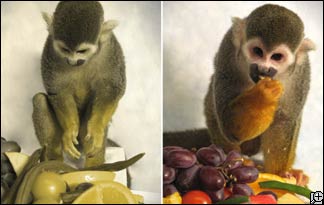
Scientists cure colour blindness in monkeys - humans next?
Researchers have delivered promising results by successfully treating two squirrel monkeys with defective colour perception using a gene therapy that could also safely eradicate colour blindness in humans. Millions of people around the world, including 3.5 million Americans, 13 million people in India and 16 million in China, are affected by colour blindness. It is a congenital problem, largely experienced by men, that renders its sufferers incapable of discerning mainly red and green hues: seemingly trivial but, in reality, a necessity for everyday practicalities such as recognizing traffic lights.
According to Jay Neitz, professor of ophthalmology at the University of Washington, “Nothing happened for the first 20 weeks…but we knew right away when it began to work. It was as if they woke up and saw these new colours. The treated animals unquestionably responded to colours that had (previously) been invisible to them.” It has taken more than 18 months of testing the monkeys' ability to discern 16 hues, with some varying as much as 11-fold in intensity. The monkeys were able to trace colour patterns on a computer touch screen and, when they chose correctly, they were rewarded with grape juice.
Read more at: http://www.gizmag.com/scientists-cure-color-blindness-in-monkeys/12881/?utm_source=Gizmag+Subscribers&utm_campaign=2f43e924c1-UA-2235360-4&utm_medium=email
Braille Label maker developed by students

Students design portable Braille label maker
Karina Pikhart ’09 displays the braille labelmaker she and her teammates designed, starting last year as a project in the Product Engineering Processes class (2.009). Photo - Patrick Gillooly;
One everyday problem for people who are blind or have very limited sight is distinguishing things that are completely identical to the sense of touch, such as different CDs and DVDs, or canned goods that are all the same size and shape. To cope with that difficulty, many people make Braille labels to attach to these items.
But the existing devices for doing this are either expensive and heavy — one costs about $650 and has limited portability — or light and inexpensive but very difficult for a blind person to operate, and limited in the number of characters they can imprint.
A team of MIT students in last fall's Product Engineering Processes (2.009) class searched for a better way. They came up with a prototype device that is small and easily portable, can produce the entire panoply of possible Braille characters (including commonly used two-character contractions), and can be relatively easily loaded and operated by touch. Although it is still under development, they hope the device, which they have named the 6dot Braille Labeler, can ultimately be produced for sale at around $200.
Some of the students continued to refine the product after the class ended, producing an improved version that won a $7,500 prize in the spring IDEAS competition (a joint project of the MIT Public Service Centre and the Edgerton Centre that recognizes innovations that benefit communities worldwide). Eight students from the mechanical engineering department, some who graduated in June and others who are still enrolled, joined by two others, are in the process of forming a company to continue development of the labeller. Over the summer they conducted field tests around the country with 25 potential users of the product, giving each about a half-hour to work with the device.
"Blind people really wanted to see this product on the market," says Karina Pikhart '09, who is CEO of the new company. "We worked really closely with blind people" in developing it, she says, because "you really can't develop a product without being in close touch with the people you're developing it for. They gave us a lot of good feedback." One of the comments they received was that the clear quality of the Braille produced by the device "felt like what really neat handwriting must look like," she says.
Read more at: http://web.mit.edu/press/2009/braille-0821.html
New vest protects from an avalanche

Avalanche Safety System
The AvaJacket is a safety vest to help skiers survive an avalanche. It features airbags that open up to restrain the head from being twisted into dangerous positions, and a breathing system that aims to separate exhaled air from the much needed oxygen rich variety.
"The device works by extracting the mouthpiece from its pocket: in just a few seconds, the airbag located in the collar is inflated around the neck of the victim, protecting a vital part of the body and decreasing the burial depth. Once submerged by the snow, the airbag slowly deflates; with its volume, around which the snow has become thick and solid, it has gained space around the victim's neck and kept the airways clear, besides having given more chances to the victim's motion and wiggle. Meanwhile, it is possible to breathe through the mouthpiece which separates the inhaled air from the exhaled air."
See the video : http://www.youtube.com/watch?v=ZynCfMFow9Q&feature=player_embedded
Virtually waterless laundry cleaning

"virtually waterless" laundry cleaning:
Now a new process is becoming available that can use as little as a cup of water and use a different sort of detergent. The next generation Eco friendly washing machine which could reduce the water usage by 90 %, this technology is developed by researchers at Leeds University, which is home to one of the UK’s most advanced textile institutes, they have established a company called Xeros Ltd to marked this laundry cleaning technology.
This technology cleans clothes using reusable nylon polymer beads with an inherent polarity that attracts stains. According to them the tiny nylon polymer beads are designed to gently but fully penetrate into a large wash load. Only a small amount of water is required to dampen the garments, loosen stains and create the water vapor that activates the “molecular magic” of the beads. The beads are then tumbled with the clothes, allowing the polarizing properties of polymer to attract and absorb dirt. Once diffused into the bead itself, stains are locked away from the garment, preventing redeposition, after washing completes this beads are automatically removed by the machine, this beads could last for about 100 loads adequate for the six months of average family usage.
Company plans to launch this laundry cleaning technology by 2010
Read more at: http://inspiredeconomist.com/2009/06/26/virtually-waterless-laundry-washing-machine/
Tuesday, September 22, 2009
Harnessing the Energy Beneath Your Tires

Introducing MotionPower™: Harnessing the Energy Beneath Your Tires
One New Jersey Burger King recently equipped its drive-thru with a speed bump that harvests electricity from cars that pass by. The speed bump is part of a pilot project from New Energy Technologies, and if all goes well, drivers could see energy-harvesting speed bumps at drive-thrus, toll plazas and even shopping centres.
The speed bumps, or “MotionPower Energy Harvesters,” look much different from your typical concrete humps. The “bump” is actually flat, with long, skinny pedals running across the top. As cars drive over the speed bump, it pushes the pedals down and turns the gears inside. The spinning creates about 2,000 watts of electricity from a car moving at five miles per hour.
Energy created by the cars is instantaneous (like solar and wind power), meaning that speed bump developers must also figure out a way to store power for later use. To that end, developers at New Energy Technologies are currently experimenting with mini-flywheels (a device that stores energy by spinning), and also plan to look into supercapacitors and other energy-storing mechanisms. Eventually, once storage is perfected, the speed bumps could be used to power street lamps or even feed power directly to the grid.
New Energy Technologies Inc.
is the first public company to develop roadway technology to capture the kinetic energy of vehicles.
Advantages:
• Cost-effective -- easy to manufacture and low operating costs
• Simple and reliable mechanical configuration which is easy to maintain
• Ease of Installation
• Low-profile assembly can be mounted directly atop existing roadways with little or no modifications to roadways
• Modular scalable configuration
• Can be installed in virtually any location
Read more at: http://www.newenergytechnologiesinc.com/
Monday, September 21, 2009
Needle Free Injections

PATEV GmbH & Co KG Developed the PYROFAST: Needle-Free Injection
PYROFAST is an innovative needle-free injection system with novel pyrotechnical gas propulsion that provides accurate and comfortable drug delivery through the skin for intra-dermal, subcutaneous, and intra-muscular injections of liquid and solid (lyophilized) drugs. The needle-free injection occurs within 40 msec; a very fine, high-pressure jet stream of liquid medication painlessly penetrates the skin, depositing medication in the tissue beneath. The skin orifice caused by the jet stream is 4 times smaller than the orifice caused by a conventional needle injection. Therefore, needle-free injection reduces skin trauma and pain and leads to better patient compliance by eliminating patient's needle-phobia. PYROFAST allows patients to self-administer their injectable medication easily.
Benefits Summary: o painless o safe o user-friendly o fast absorption o eliminates needlesticks -- no sharps to dispose of o eliminates bleeding at the injection site
Application and Potential Advantage: Vaccines, epoetin, growth hormone, sex hormones, insulin, triptans, HIV medication, heparins, interferones, hyaluronic acid, analgesics, local anesthetics, etc.
Development Summary: Prototype devices have been developed and tested.
YROFAST has been already tested and is in the prototype phase. It consists of a reusable applicator made from metal or plastic, featuring a small battery that activates the gas generator and a trigger button, plus a disposable medication unit – pre-filled single-use and a single-use unit that takes dosage from an external source.
The battery provides thousands of injections per charge.
PYROFAST’s gas generator is inspired from technologies used to activate car airbags. There is a chemical substance used by the gas generator that starts to generate gas until it reaches a reliable pressure level which causes a plunger in the ampule to push the liquid through the orifice of the noozzle.
Read more at: http://www.yet2.com/app/list/techpak?id=53072&sid=20&abc=0&page=tpprint
Plasmobot: Scientists begin design on first robot using mould
Scientists begin design on first robot using mould
Researchers have received a Leverhulme Trust grant to develop the amorphous non-silicon biological robot, plasmobot, using plasmodium, the a commonly occurring mould which lives in forests, gardens and most damp places in the UK. The Leverhulme Trust funded research project aims to design the first every fully biological (no silicon components) amorphous massively-parallel robot.
Professor Adamatzky explains, “Most people's idea of a computer is a piece of hardware with software designed to carry out specific tasks. This mould, or plasmodium, is a naturally occurring substance with its own embedded intelligence. It propagates and searches for sources of nutrients and when it finds such sources it branches out in a series of veins of protoplasm. The plasmodium is capable of solving complex computational tasks, such as the shortest path between points and other logical calculations. Through previous experiments we have already demonstrated the ability of this mould to transport objects. By feeding it oat flakes, it grows tubes which oscillate and make it move in a certain direction carrying objects with it. We can also use light or chemical stimuli to make it grow in a certain direction.
“This new plasmodium robot, called plasmobot, will sense objects, span them in the shortest and best way possible, and transport tiny objects along pre-programmed directions. The robots will have parallel inputs and outputs, a network of sensors and the number crunching power of super computers. The plasmobot will be controlled by spatial gradients of light, electro-magnetic fields and the characteristics of the substrate on which it is placed. It will be a fully controllable and programmable amorphous intelligent robot with an embedded massively parallel computer.”
Read more at: http://www.sciencedaily.com/releases/2009/08/090827073256.htm
![Reblog this post [with Zemanta]](https://lh3.googleusercontent.com/blogger_img_proxy/AEn0k_sFAsOsmJKylMCIKHv0kB_AFdrm0U-caQO9rvNpy1ZK-Iul0MMPn-OZ6ghAK-0BpKhgTURKQyntYznlXXyx4UPwhBrIQsgRSPxIQooKk6Kr7RoeTzXMklmyNlS3LNsKPksTqiNp6Ap5N81HD3UtxTvL=s0-d)
Researchers have received a Leverhulme Trust grant to develop the amorphous non-silicon biological robot, plasmobot, using plasmodium, the a commonly occurring mould which lives in forests, gardens and most damp places in the UK. The Leverhulme Trust funded research project aims to design the first every fully biological (no silicon components) amorphous massively-parallel robot.
Professor Adamatzky explains, “Most people's idea of a computer is a piece of hardware with software designed to carry out specific tasks. This mould, or plasmodium, is a naturally occurring substance with its own embedded intelligence. It propagates and searches for sources of nutrients and when it finds such sources it branches out in a series of veins of protoplasm. The plasmodium is capable of solving complex computational tasks, such as the shortest path between points and other logical calculations. Through previous experiments we have already demonstrated the ability of this mould to transport objects. By feeding it oat flakes, it grows tubes which oscillate and make it move in a certain direction carrying objects with it. We can also use light or chemical stimuli to make it grow in a certain direction.
“This new plasmodium robot, called plasmobot, will sense objects, span them in the shortest and best way possible, and transport tiny objects along pre-programmed directions. The robots will have parallel inputs and outputs, a network of sensors and the number crunching power of super computers. The plasmobot will be controlled by spatial gradients of light, electro-magnetic fields and the characteristics of the substrate on which it is placed. It will be a fully controllable and programmable amorphous intelligent robot with an embedded massively parallel computer.”
Read more at: http://www.sciencedaily.com/releases/2009/08/090827073256.htm
Portable hugs

Portable hugs: Cloth provides mechanical hug to autistic children
New Technology and New Clothing for People with Autism: Children with autism and ADHD may soon get anxiety relief from a novel "deep-pressure" vest developed by Brian Mullen at the University of Massachusetts Amherst. The vest, which can also be used for adults with mental illness, delivers a "portable hug" called deep pressure touch stimulation
People with developmental disorders and mental illness are often overwhelmed in everyday environments such as school and the workplace, and solutions available to families and mental health professionals are limited. This is an alternative therapy that can safely and discreetly provide the treatment they need to function in mainstream society.“
Mullen's vest looks pretty much like any down vest you'd want to buy, but it provides a sort of mechanical hug that calms those who are experiencing sensory overload.
Read more at: http://www.naturalnews.com/023585.html
Swish your magic wand to control your TV
Cast a spell on electronic wizardry with the Kymera Magic Wand universal remote
If you’re looking for a universal remote to complement any Harry Potter marathons screening on the tube, you might want to consider the Magic Wand universal remote control from Kymera. Sure to raise the eyebrows of any nearby muggles, the remote allows budding magicians to control their magical picture box or other piece of remote controllable electronic wizardry with a flick of the wrist - 'Abracadabra' optional.
The brain child of Brit Chris Barnardo, The Wand uses its on board processor and accelerometer to control your devices simply by moving your hand. It has predefined hand gestures from gently revolving to a quick downwards thrust, and you can assign a different command to each movement.
To turn up the volume, for example, just give the wand a clockwise motion or gesture counter-clockwise to lower it. Want to change the channel? It’s as easy as a flick of the wrist.
The wand can recognize 13 different gestures in all, and since it’s a learning remote it can be custom programmed to carry out different functions for gestures that include big swish, push forward, pull back and two single and double taps.
The Kymera Magic Wand is designed to work with just about any contraption that can be remote controlled and will be available from October 1st. Until then, Kymera is taking pre-orders for the wand, which retails at UKP£49.95 (approx. USD$83).
See more at: http://thewandcompany.com/index.html
If you’re looking for a universal remote to complement any Harry Potter marathons screening on the tube, you might want to consider the Magic Wand universal remote control from Kymera. Sure to raise the eyebrows of any nearby muggles, the remote allows budding magicians to control their magical picture box or other piece of remote controllable electronic wizardry with a flick of the wrist - 'Abracadabra' optional.
The brain child of Brit Chris Barnardo, The Wand uses its on board processor and accelerometer to control your devices simply by moving your hand. It has predefined hand gestures from gently revolving to a quick downwards thrust, and you can assign a different command to each movement.
To turn up the volume, for example, just give the wand a clockwise motion or gesture counter-clockwise to lower it. Want to change the channel? It’s as easy as a flick of the wrist.
The wand can recognize 13 different gestures in all, and since it’s a learning remote it can be custom programmed to carry out different functions for gestures that include big swish, push forward, pull back and two single and double taps.
The Kymera Magic Wand is designed to work with just about any contraption that can be remote controlled and will be available from October 1st. Until then, Kymera is taking pre-orders for the wand, which retails at UKP£49.95 (approx. USD$83).
See more at: http://thewandcompany.com/index.html
Subscribe to:
Posts (Atom)

 Posts
Posts

