Made-in-Transit Packaging
Most fresh food comes with a "best before" date, but Amsterdam-based Canadian designer Agata Jaworska thinks it should be marked "ready by." Her concept: packaging in which food can keep growing during shipping to the supermarket so that it arrives ready to be harvested, in a state of optimum freshness.
'Made in Transit' is a supply chain concept in which the production of fresh perishable food happens on the way to the supermarket, shifting the paradigm of packaging from preserving freshness to enabling growth, a shift from 'best before' to 'ready by'.
Transportation is essential in connecting distant factories, and in bringing the goods to the market, but it only serves to relocate the goods, and not to transform them in any productive way. The industry takes for granted that transportation and packaging can only locate and protect and not create or transform.
Transportation and packaging are viewed as essential yet expensive and wasteful.
But if one was to take a total chain perspective from the outset and skip steps, merge steps, or reverse the order of events, maybe transportation can be factored in as a productive creator of value.
Made in Transit is a holistic reconsideration of the product supply chain in which a synthesis of production with distribution creates a new mode of production.
Currently, 'production' equals 'transformation', 'packaging' equals 'protection' and 'distribution' equals 're-location'.
If we can turn the package into a growth condition, then the chain becomes: 1) packaging, 2) on the way growth and 3) consumption.
The packaging and distribution functions would be transformed into production. The consequences of merging production with distribution could lead to the end of the factory since distribution space simultaneously becomes production space thereby eliminating or drastically reducing the need for a land-based production facility. On-demand production could also become more of a reality. If the product can be created on the way to the market, then it does not have to be made until the order comes in. This prevents overproduction and consequent waste.
Read in more detail: http://www.foodproductiondaily.com/Supply-Chain/Made-in-Transit-The-end-of-the-factory
Watch a two minute animation: http://youtube.com/watch?v=oWcOgzNNHlE
A five minute presentation by Agata: http://youtube.com/watch?v=Oras6CRRWzQ
Thursday, June 18, 2009


Wednesday, June 17, 2009
Smog-Eating Cement

Smog-Eating Cement to help cities stay pollution-free!
Italcementi has after 10 years of research developed a special cement product aimed at providing a genuine industrialized solution to the problem of pollution in cities. Apart from being a material that essentially cleans itself, minimizing the need for maintenance, the substance TX active, which contains titanium dioxide, is a photocatalytic principle for cement products which can reduce organic and inorganic pollutants that are present in the air.
Extensive testing, sponsored in part by a European Union research project into "smart" antipollution materials, has since determined that construction products containing titanium dioxide help to destroy air pollutants found in car exhaust and heating emissions, scientists say. The substance can be used not just for the facades of buildings, but also in paint, plaster, and paving materials for roads. In one test, paving material using photocatalytic cement was used to cover the asphalt surface of a 230-meter- long stretch of road outside Milan with an average traffic flow of 1,000 vehicles per hour. Tests showed a reduction in nitrogen oxides at street level of about 60 percent, according to Italcementi. TX Active's effectiveness has been verified by independent bodies like the National Research Council (CNR).
TX Active costs about 10 times as much as normal cement, or about €1, or $1.30, per kilogram. But since the photocatalytic concrete is applied very thinly and only to areas that are exposed to the atmosphere, officials at Italcementi say, the cost of treating the façade of a five-story building with the product would be just €100 higher than with traditional paint or plaster. Paving with photocatalytic blocks would raise the price by 10 to 20 percent.
Do check the youtube link: http://www.youtube.com/watch?v=KUz32y3V72c
Tuesday, June 16, 2009
Sunscreen for Plants
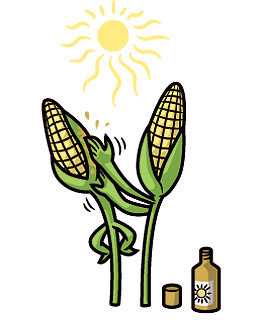
Sunscreen for Plants
According to clean chemical company Purfresh, food growers lose between 20 and 40 percent of their crops every year due to sun damage, especially in water-limited regions. The company recently developed a kind of "plant sunscreen" rated at SPF 45 that protects crops from harmful UV and IR rays while permitting beneficial rays to reach the plants.
Called "Purshade (TM)," the sunscreen reduces solar stress and improves water utilization efficiency. Growers spray the product, which can be mixed with other pre-harvest sprays, on their crops. Purshade forms a thin film of microscopic mirror-like tiny prisms that reflect certain parts of the sun's spectrum. It lasts throughout the season, and is easily removed after harvesting through traditional processing and washing.
Already, studies have shown that Purshade reduces physical damage caused by the sun in crops located around the world. Not only does it minimize crop loss, but it also improves plant quality. Purshade's developers predict that plant sunscreen will become more valuable with the increasingly harsh growing conditions and hotter climates of the future.
Check out the company’s website: http://www.purfresh.com/index.html
Google's Floating Data Center

A self-powered data center placed three to seven miles offshore, potentially operating off the grid: Standard shipping containers would house racks of computers that could be transported by truck and placed onto a boat by crane.
The hidden cost of the triumph of the Internet is the rise of the data center. The Net runs on huge complexes of hot, power-hungry servers that eat up real estate and energy in massive quantities — in 2006 data centers consumed a staggering 1.5% of the U.S.'s entire supply of electricity. Engineers at Google may have found a way out: the self-sufficient floating data center. According to a patent filed by Google, wind turbines and wave-powered generators will provide the electricity. Ocean water will cool the servers, which throw off huge amounts of heat. And offshore real estate is essentially free.
A wave-power generator would be the primary source of electricity. But wind turbines could be used to, for example, run water pumps and a tidal power generator could be used in rivers. The patent specifies the use of a so-called Pelamis machine, which uses pontoons with pumps to convert wave motion into electricity. A British company, Pelamis Wave Power, is operating a prototype in Scotland and intends to install one off Portugal.
Google engineers calculate that an array of pontoons spread over a square kilometer (a bit more than a half mile) could produce 30 megawatts of electricity, enough to operate a single system.
Read more at : http://www.datacenterknowledge.com/archives/2008/09/06/google-planning-offshore-data-barges/
http://news.cnet.com/8301-11128_3-10034753-54.html
Monday, June 15, 2009
Switch computer on/off like a switch

Researchers at HP Labs have solved a decades-old mystery by proving the existence of a fourth basic element in integrated circuits that could make it possible to develop computers that turn on and off like an electric light. The memristor — short for memory resistor - could make it possible to develop far more energy-efficient computing systems with memories that retain information even after the power is off, so there's no wait for the system to boot up after turning the computer on. It may even be possible to create systems with some of the pattern-matching abilities of the human brain.
The memristor first appeared in a 1971 paper published by Professor Leon Chua, a distinguished faculty member in the Electrical Engineering and Computer Sciences Department of the University of California Berkeley.Chua described and named the memristor, arguing that it should be included along with the resistor, capacitor and inductor as the fourth fundamental circuit element. The memristor has properties that cannot be duplicated by any combination of the other three elements.
"To find something new and yet so fundamental in the very mature field of electrical engineering is a big surprise," said R. Stanley Williams, an HP Senior Fellow and director of the Information and Quantum Systems Lab (IQSL).
Brain-like systems?
As for the human brain-like characteristics, memristor technology could one day lead to computer systems that can remember and associate patterns in a way similar to how people do.
This could be used to substantially improve facial recognition technology or to provide more complex biometric recognition systems that could more effectively restrict access to personal information.
These same pattern-matching capabilities could enable appliances that learn from experience and computers that can make decisions.
http://www.hpl.hp.com/news/2008/apr-jun/memristor.html
http://en.wikipedia.org/wiki/Memristor

Science to help reinvent economy
Can science reinvent the economy?
We have created a monster. Financial markets have grown so complex that neither intuition nor standard economic models can get to grips with them. So what's to be done to avoid a repeat of the financial disasters of the past couple of years? In this special feature, Mark Buchanan looks at some of the creative ideas being explored to tame the markets, not just by economists, but by physicists, engineers, biologists and others.
1. Bubble math : Common sense would have suggested that the huge housing bubble would lead to disaster: so why did some financial institutions assess risks with models that ignored the possibility that prices might fall?
2. The human factor : Purely mathematical approaches to predicting the economy have a big drawback – the irrational behaviour of people
3. Network solutions : Bubbles are nothing new, but now a bubble in just one country can cause the whole world's economy to collapse – so how do we stop the dominoes toppling?
4. Predicting the big one : According to classical economics, financial crises don't happen – clearly, then, there is a lot wrong with classical economics
5. An economy in a computer : Can we pack an entire economy, with all its complex human and political interactions, into a computer? Yes, say experts, as long as we're bold enough about it
6. Out of kilter : Trying to predict markets in the same way as earthquakes comes with the same limitations – it does not tell us when and where the next cataclysmic event will be
7. Will it be enough? : For all science can tell us, we might in the end have to accept that we are at the mercy of the markets – and ultimately human nature
An Excerpt from Out of kilter :
Trends in macroeconomics are the sum of microeconomic decisions, but attempts to extrapolate from the one to the other are by necessity grossly oversimplified, says Eric Weinstein, a physicist who works for the Natron Group, a hedge fund in New York City. At the moment, that ideal is confounded by the sheer number of individual interactions in any real market. The result is a gaping divide between microeconomics (the study of how individual people and companies in a market make decisions to buy and sell) and macroeconomics (the study of movements in economy-wide indicators such as GDP, inflation and unemployment).
Might physics help in bridging the divide? Physics also deals separately with the microscopic - the individual movements of particles in a gas, say - and the macroscopic, for example when the sum of those movements creates a pressure that enables a gas to push a piston. But it also has mathematical frameworks, such as statistical mechanics, capable of bridging the gap between them.
Weinstein has been involved in one of the most audacious attempts to meld physics and economics: showing how gauge theory, the mathematical underpinning of the quantum field theories of the standard model of particle physics, might be the key to a rational theory of economics based only on physically observable quantities, rather than hypotheticals akin to the economists' list of ordered preferences. Impressed by this idea, physicist Lee Smolin of the Perimeter Institute in Waterloo, Ontario, Canada, has recently studied how gauge theory ideas might be incorporated into some basic economic theories about how markets work.
Some physicists suggest that these models can be used to identify particular moments when markets are likely to make big moves. Neil Johnson of the University of Miami in Florida has used agent models to show how "windows of predictability" open up when many agents come to hold similar beliefs, meaning that they are likely all to act in a similar way in the near future. In one demonstration, he and his colleagues were able to use this technique to predict the movements of a foreign exchange market with more than 90 per cent accuracy
'Beehive fence' deters elephants
'Beehive fence' deters elephants : SIMPLE BUT EFFECTIVE
A simple fence made from wood, wire and beehives can deter elephants from raiding farmers' crops. A pilot study in Kenya has shown that such fences reduce the number of raids by elephants by almost half. The work is the culmination of previous research which showed elephants are naturally scared of African honey bees.
A much larger trial is now under way in the hope the fences will provide an elegant solution to years of conflict between elephants and farmers. In Kenya, elephants are not confined to national parks or reserves. As they roam, they often come across increasing numbers of farms created by pastoralists who are being encouraged to settle down and grow crops.
The elephants break into the farms and raid them for food such as ripe tomatoes, potatoes and maize. That causes significant economic damage and conflict with farmers who occasionally resort to shooting, spearing or poisoning elephants to protect their livelihoods and families.
So researchers from a British university worked with the charity Save the Elephants to conduct a pilot study of a novel "beehive fence". The design is based on the idea that elephants are wary of honey bees in the wild. In 2002, University of Oxford zoologist Fritz Vollrath discovered that elephants avoided trees with beehives in. Colleague Lucy King followed this idea up by showing that elephants would quickly move on even if they heard the sound of a buzzing hive.
Now a team led by King, including Vollrath, has taken the idea to its logical conclusion - the creation of a fence containing beehives. In the Ex-Erok community in the southern region of Laikipia, Kenya, the team recruited farmers whose crops were regularly raided by elephants. Around the side of one farm, nine traditional log beehives were hung under small thatched roofs, with each being linked by wire. In all, the fence continued for 90m with each hive 10m apart. The hives were left empty.
Innovative contact lenses look to dispense drugs

Eye-drops may be a simple way of medicating the eye, but patients don't always get the right dose at the right time. Eyenovations has developed contact lenses that can deliver drugs to the eye in measured doses for a month or longer. The start-up company's initial focus is developing a lens to help glaucoma patients. However, it believes the technology can be used to help other eye conditions and deliver antibiotics following surgery.
Glaucoma affects about 2.5 million Americans each year and the numbers are growing. Treatment involves administering eye-drops up to eight times a day but, because patients often have few symptoms, especially in the early stages, many give up on their medication regime. A self-medicating lens could greatly help these people as well as the elderly, disabled, inhabitants of remote areas and others who find it difficult to stick with a regimented schedule
The team from Cambridge, Massachusetts has developed the drug-dispensing technology using a hydro-gel lens with a polymer film inside, which contains the medication.
The lens gradually releases the medication at a rate determined by the properties of both the lens and polymer film. Future versions may allow the medication to be stored in the hydro-gel material of the lens. This ensures patients with eye conditions requiring drops, especially those who struggle to follow a medication schedule, receive the right amount of medication at the right time.
Read full article: http://www.gizmag.com/innovative-contact-lenses-look-to-dispense-drugs/11792/

Algae could give biofuels
NASA Envisions "Clean Energy" From Algae Grown in Waste Water
NASA scientists have proposed an ingenious and remarkably resourceful process to produce "clean energy" biofuels, that cleans waste water, removes carbon dioxide from the air, retains important nutrients, and does not compete with agriculture for land or freshwater.
Algae are similar to other plants in that they remove carbon dioxide from the atmosphere, produce oxygen as a by-product of photosynthesis, and use phosphates, nitrogen, and trace elements to grow and flourish. Unlike many plants, they produce fatty, lipid cells loaded with oil that can be used as fuel.
"The inspiration I had was to use offshore membrane enclosures to grow algae. We're going to deploy a large plastic bag in the ocean, and fill it with sewage. The algae use sewage to grow, and in the process of growing they clean up the sewage," said Jonathan Trent, the lead research scientist on the Spaceship Earth project at NASA Ames Research Center, Moffett Field, Cali.
It is a simple, but elegant concept. The bag will be made of semi-permeable membranes that allow fresh water to flow out into the ocean, while retaining the algae and nutrients. The membranes are called "forward-osmosis membranes." NASA is testing these membranes for recycling dirty water on future long-duration space missions. They are normal membranes that allow the water to run one way. With salt water on the outside and fresh water on the inside, the membrane prevents the salt from diluting the fresh water. It's a natural process, where large amounts of fresh water flow into the sea.
Floating on the ocean's surface, the inexpensive plastic bags will be collecting solar energy as the algae inside produce oxygen by photosynthesis. The algae will feed on the nutrients in the sewage, growing rich, fatty cells. Through osmosis, the bag will absorb carbon dioxide from the air, and release oxygen and fresh water. The temperature will be controlled by the heat capacity of the ocean, and the ocean's waves will keep the system mixed and active.
When the process is completed, biofuels will be made and sewage will be processed. For the first time, harmful sewage will no longer be dumped into the ocean. The algae and nutrients will be contained and collected in a bag. Not only will oil be produced, but nutrients will no longer be lost to the sea. According to Trent, the system ideally is fail proof. Even if the bag leaks, it won't contaminate the local environment. The enclosed fresh water algae will die in the ocean.
The bags are expected to last two years, and will be recycled afterwards. The plastic material may be used as plastic mulch, or possibly as a solid amendment in fields to retain moisture.
For full article read: http://www.nasa.gov/centers/ames/news/features/2009/clean_energy_042209.html
Tuesday, June 9, 2009
SEE THROUGH FISH- to help study cancer
Scientists Create See-Through Fish, Watch Cancer Grow:
A newly bred fish bares all in the lab, revealing brain, heart and other internal organs in the name of research.
Scientists are breeding zebrafish with see-through bodies in order to make studying disease processes easier, including the spread of cancer.
The transparent fish, described in the Feb. 7 issue of the journal Cell Stem Cell, are allowing researchers at Children's Hospital Boston to directly view fish's internal organs and observe processes such as tumor growth in real-time in living organisms.
Scientists previously studied disease in the embryos of zebrafish, which are naturally transparent. But their clear bodies turn opaque when they grow into adults. The newly created zebrafish stays transparent throughout its lifetime.
Traditionally, researchers have relied on information collected after the diseased animal died to infer anything about human ailments. But for rapidly changing processes such as cancer, this snapshot method is bound to miss something. "It's like taking a photograph when you need a video," said White, also an instructor of medicine at the Dana-Farber Cancer Institute in Boston.
White created the transparent fish, which he nicknamed Casper, by mating two existing zebrafish breeds, one that lacked a reflective skin pigment and the other without black pigment. The offspring had only yellow skin pigment, essentially appearing clear.
In one experiment, White and his colleagues inserted a fluorescent melanoma tumor into the abdominal cavity of the transparent fish. By observing the fish under a microscope, they found that the cancer cells started spreading within five days. White could actually see individual cells spreading.
"The process by which a tumor goes from being localized to widespread and ultimately fatal is the most vexing problem that oncologists face," White said. "We don't know why cancer cells decide to move away from their primary site to other parts in the body."
The spreading melanoma cells appeared to flock toward the skin after leaving the abdominal cavity. "This told us that when tumor cells spread to other parts in the body, they don't do it randomly," White said. "They know where to go."
Read more at: http://cosmiclog.msnbc.msn.com/archive/2008/02/06/644161.aspx
Wednesday, May 27, 2009
Cell Phone for Blind people
CELL PHONE FOR THE BLIND AND FOR INDIVIDUALS WITH LEARNING DISABILITIES
Blind users hear the contents of the document read in clear synthetic speech, while users who can see the screen and those with learning disabilities can enlarge, read, track, and highlight printed materials using the phone's large and easy-to-read display. The combination of text-to-speech and tracking features makes interpreting text much easier for individuals with learning disabilities.
K -NFB Reading Technology, a company combining the research and development efforts of the National Federation of the Blind and Kurzweil Technologies, unveils an exciting product line that will revolutionize access to print for anyone who has difficulty seeing or reading print, including the blind and learning disabled. The company’s world-renowned reading software has been especially designed for and paired with the Nokia N82 mobile phone to create the smallest text-to-speech reading device in history.
Cell phone and Reader combination
Blind users will have access to all of the functions featured in the most advanced cell phones on the market including video and music playback, GPS, wireless communications, photography, e-mail, text messaging, calendar and task functions, and more. The combination Reader and cell phone weighs 4.2 ounces and can store thousands of printed pages with easily obtainable extra memory. Users can transfer files to computers or Braille notetakers in seconds.
knfbREADER Mobile with a user friendly interface
"The knfbREADER Mobile allows me immediate access to printed information, whether it be a menu or a letter," said James Gashel, vice president of business development for K-NFB Reading Technology, Inc. and a blind user of the product. "So many people already carry cell phones. This innovation is exciting because it puts all of the functions that users need into one product, eliminating the need to carry multiple devices. The Reader's simple user interface makes it ideal for the growing number of blind seniors."
Cell phone for disabled people
"Technology that enlarges the printed word or converts it to speech has dramatically improved the lives of millions of Americans with many types of disabilities, enabling them to read and comprehend printed materials to which they never before had access," said Ray Kurzweil, President and CEO of K-NFB Reading Technology, Inc. "This innovation has created opportunities disabled people had never considered before due to the large amounts of reading required in certain occupations. The first machine of this type was the size of a washing machine. As optical character recognition technology is integrated into smaller and smaller devices, access to print becomes available almost instantaneously."
Wind turbine which needs to pillars to hold it
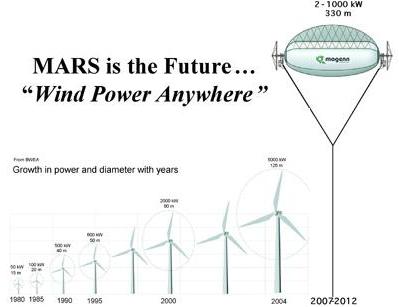
WIND TURBINE WHICH NEEDS NO SUPPORTING INFRASTRUCTURE TO DEPLOY
Magenn Power's MARS is a lighter-than-air tethered wind turbine that rotates about a horizontal axis in response to wind, generating electrical energy. This electrical energy is transferred down the 1000-foot tether for immediate use, or to a set of batteries for later use, or to the power grid.
Helium sustains MARS and allows it to ascend to a higher altitude than traditional wind turbines. MARS captures the energy available in the 600 to 1000-foot low level and nocturnal jet streams that exist almost everywhere. MARS rotation also generates the "Magnus effect" which provides additional lift, keeps the MARS stabilized, and positions it within a very controlled and restricted location to adhere to FAA (Federal Aviation Administration) & Transport Canada guidelines.
Magenn Power's MARS is a Wind Power Anywhere™ solution with distinct advantages over existing Conventional Wind Turbines and Diesel Generating Systems including:
• global deployment,
• better operational performance and lower handling, transporting, and storage costs.
removes all placement limitations. MARS is mobile and can be rapidly deployed, deflated, and redeployed without the need for towers or heavy cranes.
• MARS is bird and bat friendly with lower noise emissions
• is capable of operating in a wider range of wind speeds - from 4 mph to greater than 60 mph.
MARS can complement a diesel generator by offering a combined diesel-wind power solution that delivers power below 20 cents per kWh.
• The MARS combined solution allows lower pollution and green house gas emissions.
MARS Target Markets: Developing nations where infrastructure is limited or non existent; off-grid combined wind and diesel solutions for island nations, farms, remote areas, cell towers, exploration equipment, backup power & water pumps for natural gas mines; rapid deployment diesel & wind solutions (to include airdrop) to disaster areas for power to emergency and medical equipment, water pumps; on-grid applications for farms, factories, remote communities; and wind farm deployments.
Magenn Power is currently in the prototype phase of our Magenn Air Rotor System (MARS). Magenn Power plans to ship our first official product, a 100 kW version in the later part of 2009 to test customers. Full production will begin in 2010/11.
For greater detail of technology : http://www.magenn.com/technology.php
For Video see: http://www.magenn.com/media/video/player.html?v=JDJhhGJwSuA&hl=en
Tuesday, May 26, 2009
A 4 wheeler motorcycle
Sideways on a tilting 4-wheeler: the next generation of fun machines
Enjoy the ride!: http://www.youtube.com/watch?v=j127RX9S7vw&feature=player_embedded
The additional stability and traction you get from a tilting three-wheeler is quite an eye-opener, and they're still exceptionally fun to ride. If you want to take the concept one step further, though, an extra wheel at the back as well can actually make the entire bike narrower while delivering the sort of stability that can let you safely powerslide and drift all four wheels on an oily skidpan.
The extra fourth wheel on the 4MC prototype gives a much broader balance range for the bike's center of gravity - so it's happy to sit at full lean at a standstill OR when being belted around a tight corner.
As the lean angle increases, the wheels move slightly further apart, increasing stability when you really need it - and this works as a backup system when you park the bike and leave it on an angle - the tires grip and prevent the bike from tilting any further.
Steering is handled by a pair of upwardly looping front suspension arms, which allow a nice tight turning circle. Like a bike, you'll countersteer the 4MC into corners - and the combination of leaning into the corners while having the stability and grip of 4 wheels means that the 4MC will use its grip much more effectively than a car can. A sporty tilting 4-wheeler could end up being exceptionally fast in the twisty stuff.
The 4MC is the original work of engineer and company director Nick Shotter. He has specifically designed the 4MC to get its rider through traffic safely yet efficiently.
His interest in safety originated from being injured in a road accident when working as a London motorcycle courier. The 4MC has evolved through Nick's rigorous design process which began in 1989. In 2000 the 4MC won a DTI Smart Award for a Feasibility Study. From 2002 Nick introduced the 4MC to many well known manufacturers with an invitation to buy the 4MC's intellectual property (IP). Between 2004 and 2008 he built a full sized working prototype to further demonstrate the 4MC.
The 4MC’s unique designs are covered by several patent applications. The 4MC’s patent applications, trademark, and prototype are all part of the 4MC’s IP. At this stage the IP is available for sale. Once the patent applications have been granted the IP will be available for either sale or license. The prototype’s purpose is to demonstrate the 4MC. To achieve this it was not necessary to equip the prototype with mudguards, lights, or bodywork. The prototype is very sure footed and terrific fun to ride.
Visit the website: http://www.4-mc.co.uk/
Read full details at: http://www.gizmag.com/sideways-on-a-tilting-4-wheeler-the-next-generation-of-fun-machines/11627/
Monday, May 25, 2009
Make your own spectacles

Inventor designs 'tunable' glasses to help one billion in Third World see
The need: The U.K Guardian reports that there is one optometrist for every 4,500 people in Britain, while in sub-Saharan Africa the ratio is 1:1,000,000.
The Innovator: Joshua Silver who was a professor at Oxford University,
The innovation: His adaptive glasses are designed to be "tuned" by the wearer to suit their eyes without the need for a prescription and can help both short-sighted and long-sighted people. Working on the principle that thicker lenses are more powerful than thin ones, Prof Silver's spectacles can be adjusted by injecting tiny quantities of fluid. The tough plastic glasses have thin sacs of silicone liquid in the centre of each lens. They come with small syringes attached to each arm with a dial for the wearer to adjust the amount of light-bending silicon until they can see clearly. Once the lenses have been adjusted, the syringes are removed and the spectacles worn just like a prescription pair. They are similar to wearing double paned windows with a gel in between. The current price is a pretty cheap $19.
The journey: He set on the idea of developing an adjustable spectacle after a chance conversation in 1985 when he and a colleague were discussing optical lenses. It took more than 20 years to finally come up a design which can be made cheaply on a large scale. Today, his invention is being worn in more than 10 countries, including African villages. Soon, the poor of India also will be sporting Silver’s spectacles.
Along his journey to delivering a viable product, Silver won a Popular Science Best of What’s New Award in 2000. His AdSpecs were featured again in the magazine’s March 2009 issue. He has steadfastly followed an arduous journey, and refuses to sell his idea for monetary gain. No IPO in this man’s future, although he said he has been offered millions for his design. He is afraid that another company wouldn’t make the world’s poor their priority. So, he looks for philanthropists who are interested in ministering to the disadvantaged. He was recently joined by an Indian businessman, and together they plan to provide one million pairs of glasses in India.
The Future: Professionals devoted to eyesight problems are few and far between in developing countries. Silver hopes to deliver self-adjusting eyeglasses to 1,000,000 underserved Indian people.
Money is a factor, of course. Silver is aiming to distribute 100 million pairs each year. Getting the production costs down to a dollar a pair is more than a challenge, even in lots of a million at a time. Oxford University has agreed to host a Centre for Vision in the Developing World, with plans to work on a World Bank-funded project. Hopefully, that will attract more funds for Silver’s humanitarian cause.
You tube video: http://www.youtube.com/watch?v=W4OiRjv81BY
Here’s a link to the story: http://www.telegraph.co.uk/health/healthnews/3899781/Inventor-designs-tunable-glasses-to-help-one-billion-in-Third-World-see.html
Naturally innovative: A briefing paper for the construction industry

The construction industry and its clients are increasingly being challenged to achieve cost savings and better performance of built assets. Biomimetics has already shown its potential to help with these issues.
Biomimetic ideas and products have the potential to help the construction industry and its clients with demands for:
• Reduced embodied energy (CO2) in construction products
• Reduced materials use, better resource efficiency and hence lower cost
• Reduced weight and complexity (lighter structures, response to manual handling regulations, etc)
• Novel designs
• Reduced maintenance burdens (intervals and costs).
Some examples of its usage include:
Project type Commercial examples of biomimetics Biological analogue
Housing Self-cleaning façade paints Lotus leaf structure
Buildings – commercial and industrial Self-cleaning façades paints and glasses,
Architectural features or structures (such as Stuttgart airport) Lotus leaf structure
Branching tree structures
Logistics Delivery logistics software Interactions within ant colonies
Pavements, roads, car-parks, airports etc Catseyes® Optical reflectivity of cats eyes
Civil Engineering structures (e.g. bridges, tunnels) Tensairity® beams Plant cell wall structures
Please follow the link to read this very interesting paper: http://www.bre.co.uk/filelibrary/cap/Biomimetics.pdf

Subscribe to:
Posts (Atom)

 Posts

