Thursday, May 21, 2009

You reading glasses provide light


LED Light Reading Glasses
• Glasses are magnified 2.5 times to make reading or project-working easier
• Frames have two LEDs built in to light up your book or project, eliminating the need for a flashlight
• Batteries (included) provide 25 hours of continuous use

Shed light on your project without using your hands. The LED Lighting Reading Glasses are ideal for plumbers, electricians, automotive professionals or installers who may be working in the dark. These lightweight, comfortable glasses shine two ultra-bright LEDs onto your project, so you won't need to use one of your hands to hold a flashlight. And because the lenses are magnified 2.5 times, you can even use them to read in bed at night without disturbing your spouse. Whether traveling by plane, bus, train, or car, these unobtrusive LED Lighting Reading Glasses (carrying case included) are especially convenient when the overhead light isn't enough to illuminate your space.

Giant Sea Snake Renewable Electricity Generation

Pelamis wave energy converter on site at the E...Image via Wikipedia

The Pelamis Wave Energy Converter is a technology that uses the motion of ocean surface waves to create electricity. The machine is made up of connected sections which flex and bend as waves pass; it is this motion which is used to generate electricity.
Developed by the Scottish company Pelamis Wave Power (formerly Ocean Power Delivery), it was the world’s first commercial scale machine to generate electricity into the grid from offshore wave energy and the first to be used in commercial wave farm project. The first full scale prototype was successfully installed and generated electricity to the UK grid at the European Marine Energy Centre in Orkney, Scotland in August 2004. The first wave farm consisting of three Pelamis machines and located off the coast of Portugal, was officially opened in September 2008. It has an installed capacity of 2.25MW, enough to meet the average electricity demand of more than 1,500 Portuguese homes.

The pelamis device consists of a series of semi submerged cylindrical sections linked by hinged joints. The wave induced relative motion of these sections is resisted by hydraulic rams which pump high pressure oil through hydraulic motors via smoothing accumulators. The hydraulic motors drive electrical generators to produce electricity. Power from all the joints is fed down a single umbilical cable to a junction on the sea bed. Several devices can be connected together and linked to shore through a single seabed cable.

See how it works: http://www.youtube.com/watch?v=F0mzrbfzUpM&feature=player_embedded
http://www.youtube.com/watch?v=mcTNkoyvLFs


Reblog this post [with Zemanta]

Sunday, May 17, 2009

Life Without Cars? It's happening.


In German Suburb, Life Goes On Without Cars

VAUBAN, Germany — Residents of this upscale community are suburban pioneers, going where few soccer moms or commuting executives have ever gone before: they have given up their cars.

Vauban’s streets are completely “car-free” — except the main thoroughfare, where the tram to downtown Freiburg runs, and a few streets on one edge of the community. Car ownership is allowed, but there are only two places to park — large garages at the edge of the development, where a car-owner buys a space, for $40,000, along with a home.

As a result, 70 percent of Vauban’s families do not own cars, and 57 percent sold a car to move here. Vauban, completed in 2006, is an example of a growing trend in Europe, the United States and elsewhere to separate suburban life from auto use, as a component of a movement called “smart planning.”

In the United States, the Environmental Protection Agency is promoting “car reduced” communities, and legislators are starting to act, if cautiously. Many experts expect public transport serving suburbs to play a much larger role in a new six-year federal transportation bill to be approved this year, Mr. Goldberg said. In previous bills, 80 percent of appropriations have by law gone to highways and only 20 percent to other transport.

In California, the Hayward Area Planning Association is developing a Vauban-like community called Quarry Village on the outskirts of Oakland, accessible without a car to the Bay Area Rapid Transit system and to the California State University’s campus in Hayward.

Passenger cars are responsible for 12 percent of greenhouse gas emissions in Europe — a proportion that is growing, according to the European Environment Agency — and up to 50 percent in some car-intensive areas in the United States.

Read full article: http://www.nytimes.com/2009/05/12/science/earth/12suburb.html?emc=eta1

Wednesday, May 13, 2009

Lip-Reading Computers

Lip-Reading Computers Can Recognize Different Languages
Lip-reading computers for deaf people are a step closer with scientists successfully teaching computers to recognize different languages from the shapes and movements of people's mouths. This could also be used for converting videos of conversations into written transcripts.
Researchers have identified that each speech sound has a particular facial and mouth position, which can be mapped on video and then processed by software that associates the various orientations with the sounds they produce. The technology focuses on mapping the facial movements, called 'features', and converting them into signals which the software can process and 'translate' into text.
Researchers at the School of Computing Sciences at the University of East Anglia conducted statistical modeling of the lip motions of 23 bilingual and trilingual speakers. The languages tested included English, French, German, Arabic, Mandarin, Cantonese, Italian, Polish and Russian, and the system was able to identify with very high degree of accuracy which language was spoken by an individual speaker.

"This is an exciting advance in automatic lip-reading technology and the first scientific confirmation of something we already intuitively suspected -¬ that when people speak different languages, they use different mouth shapes in different sequences," said Professor Cox who, along with PhD student Jake Newman, led the team.

For full article read at: http://www.gizmag.com/lip-reading-computers-can-recognize-different-languages/11551/
For video check: http://www.newscientist.com/articlevideo/mg20227055.800/20478996001-lipreading-computer-picks-out-your-language.html

Tap water to provide electricity


Hydro Turbine Concept Harvests Electricity From Water Pressure

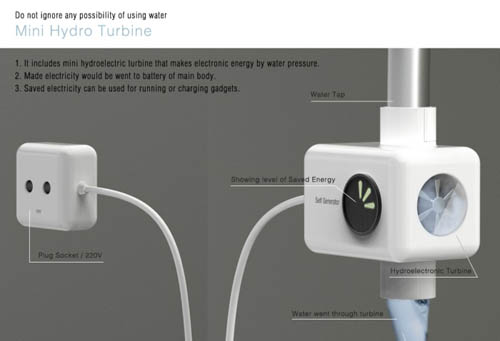
If Jin Woo Han's concept Mini Hydro Turbine goes into production we will have a home gadget to power objects like Hair dryer, electric shaver, mixer, electric toothbrush, water boiler, etc..

It can be attached to the end of your faucet or between two pipes. It’s designed to attach to any pipe to make use of water pressure.
The water runs through the device, activating the hydroelectronic turbine. Energy is stored up in the electricity generator, which is connected to the plug socket.


Read more: http://www.yankodesign.com/2009/03/31/water-generates-free-personal-electricity/

Nature inspires design for all fluid-moving machinery

The logarithmic spiral of the Nautilus shell i...Image via Wikipedia


What is common in all above pictures? Spirals!
PAX Scientific CEO Jay Harman is the first person to isolate the geometries that underlie natural flow and adapt those geometries to technology. From his observations, he asked a simple question: “If fluids always tend to follow a particular path, is there a way to design equipment that takes advantage of this fact?”

Cameron Burns from Rocky Mountain Institute wrote in 2002 that “Pax’s impeller design is based on a logarithmic spiral known as a Phi Ratio or Fibonacci Sequence that occurs in many places in nature, yet few designers have ever mimicked them. When rotated in water or air, the impeller makes the fluid flow smoothly in a vortex, like water exiting a bathtub. In contrast, the most common kinds of conventional pumps and fans sling the fluid outward and bounce it off a curved wall to make some of it move in the desired direction.”

PAX Impeller could revolutionise fluid-moving machinery like pumps, fans, propellers, mixers, and turbines.

Now based in the US, Australian Scientist Jay Harman, CEO of PAX Scientific is designing new fan technology that claims to have energy savings of 50%, and be around 75% quieter compared to fans, impellers and propellers using traditional shapes and designs. Harman had his moment of inspiration when he was 10-years-old, swimming off the coast in Western Australia. Like almost every young Australian he wanted to swim faster, so he watched how fish moved through water and how seaweed moved against the reef when a wave crashed. He noticed that kelp moved in the shape of a spiral to withstand the force of the waves and noticed spirals as a common design pattern in nature.

Until Harman’s work, no one had used this natural design shape for fans, impellers or propellers, even though it is used widely to reduce friction for air and water flows in nature.

Check this video: http://www.youtube.com/watch?v=by0JhirtO-0


Reblog this post [with Zemanta]

Sunday, May 10, 2009

Preventing bacteria build-up - Nature's way


Nature’s design to prevent bacteria build up.

How do you prevent bacterial build-up or biofilms (bacterial colonies) on boats or any surface in water, using an environmentally benign approach with no heavy metals or harmful chemicals? Sydney-based Professor Peter Steinberg found such a solution. Biosignal technology prevents or disrupts resistant biofilms without killing bacteria.This unique approach to bacterial control is aimed at delivering effective treatments whilst sidestepping the issue of bacterial resistance.

Steinberg explains how they came across their discovery: “Shallow marine organisms are subjected to a rain of fouling organisms from the water column –bacteria, algal spores, larvae – and so the ones with clean surfaces in those habitats are worth paying attention to. Steinberg and his colleague Staffan Kjelleberg discovered that the Delisia Pulchra plant didn’t kill bacteria. Instead, it emitted a molecule, furanones, to dissuade bacteria from colonising on its surface, effectively jamming the bacteria’s communication networks. The furanones jam cell-to-cell signaling systems that are pivotal to the ability of bacteria to form and maintain biofilms
Using this insight, they mimicked the chemical and have subsequently invented an environmentally friendly antifouling substance that can be used on surfaces in hospitals, contact lenses and paints to reduce slimy build-ups in an environmentally benign manner. The company they founded to commercialise this technology, Biosignal, was incorporated in 1999 and listed on the ASX in early April 2004.

Biosignal has the great advantage of multiple applications for its technology. Since the late nineties, the company has tested antibiofilm compounds and generated proof of concept data in a broad range of product categories in the medical, industrial and consumer fields. Specific products where proof of concept data has been generated include oil and gas, marine anti-fouling paints, water treatment applications, oral care products, cleaners, deodorants, contact lenses and contact lens solutions, catheters, and as a drug candidate for the treatment of lung infections.

Check the video at : http://www.biosignal.com.au/bioanimation.php

Friday, May 8, 2009

Whales teach how to clean: biomimetic's example


Baleen Filter technology is an example of biomimetic engineering. This is an adaptation of the technique used by filter-feeding whales to keep their baleen clean and free of debris. The baleen is the filter mechanism that allows the whale to collect and filter plankton, small fish and other marine organisms from the water during feeding.

Unique Filtering Process
The Baleen filter technology, is based on a simple, yet ingenious ‘double-act’ of high pressure, low volume sprays, one of which dislodges material caught by the filter screen media, while the other sweeps it away for collection. As water flows through the filter, substances initially suspended in the water are left behind by the filtrate, but before they are allowed to accumulate and blind the filter’s screen, the ‘double-act’ effects their removal from the filtering zone thereby sustaining the filtering process.

The principles of operation rely upon the response of particle (and droplet) dynamics to fluid flow within a nonpressurised, open system. Continued reliability of the Baleen filtering process is achieved by ‘state-of-the-art’ process control to ensure trouble-free coarse screening to 250-micron, micro-screening to less than 100-micron and microfiltration to less than 5-micron (when using chemical assistance). The Baleen filter is especially effective in water treatment approaches where waterborne materials were previously regarded as problematic to conventional screening and filtration processes. This mechanism allows industrial wastewater with higher pollutant loads to be filtered than was previously possible with conventional industrial filters.

The Baleen filter is a highly efficient, non-pressurised self-cleaning separation technology that achieves reliable filtration to 25 microns without chemical assistance. It offers significant cost and environmental benefits.
The company Baleen Filters was established in 1999 after a four-year industrially applied research and development program from the University of South Australia. Yuri Obst was the originator of the idea and is now Managing Director of Baleen Filter.

This can be used in the following industries: Food Processing, Beverage :Wine Industry, Meat & Livestock: Pig Industry, Fruit & Vegetable Packing: Carrots, Dried Fruit, Transport: Truckwash

For more details see the brochure of company: http://www.baleenfilters.com/pdf/Technology_Brief.pdf

Process video: http://www.baleenfilters.com/product_movie_qt.asp

Thursday, May 7, 2009

Device Turns A Cellphone Into A Microscope


“Say you're in a remote or undeveloped part of the world, and you have to diagnose an illness. Even if you could find a microscope, you don't have a doctor to look through it, but you do have a cell phone. What if you could attach the phone to the microscope, call another cell phone halfway around the world, and have the doctor with this phone see what the microscope sees? That's the idea behind CellScope.”
The new CellScope turns a standard camera cell phone into a microscope of clinical quality with a magnification of up to 50X. This proves to be of great value for the health workers in the developing countries, where there is scarcity of proper equipments due to heavy cost or physicians. In such places and conditions the CellScope plays a vital role as the health workers can easily capture necessary images of blood cells and infections and then transmit through the cell phone network to the experts for further analysis.

The CellScope, developed by the research scholars of University of California at Berkeley is not just a fun device but has the potential to save lives even. Just by clipping the device to your camera cell phone, PDA or netbook, you can easily collect and organize data of patients. The organized data can then be sent wirelessly to the remote experts and receive instant response as well. The CellScope can be clipped easily to the cell phone with the help of a modified belt clip. A set of high brightness white LEDs are responsible for providing the illumination. These LEDs draws their power from the battery attached to the device. The CellScope can be angled so as to illuminate any sample fully at its focal point.
The team believes that if mass produced, the device could be sold for around $50, an incredible price for a clinical quality microscope that can send diagnostic data all over the world.

The CellScope has been awarded with a cash prize of $100,000 in the Intel INSPIRE EMPOWER Challenge and was also a winner of Vodafone Americas Foundation Wireless Innovation Project. But this is not the end as research team is constantly testing the device rigorously so as to come up with some advance version of it. The cash prize would be used in the improvement of the device, as planned by the research team members.

You tube video: http://www.youtube.com/watch?v=J_44YIAGpf4

Tuesday, May 5, 2009

Fish make fishing easy- come and say catch me!

Relax! The fish will call the fisherman
Student’s invention uses mobile phone technology to alert owner of the catch :

The star attraction on the first day of a national scientific conference in Nairobi on Monday was a simple technology that could dramatically change the way small-scale fishermen attract their catch.

Designed by Mr Pascal Katana, a student at the University of Nairobi, the electronic trap lures fish into their captivity by imitating the sound they make when feeding.
“The sound is inaudible to the human ear, but it attracts other fish, and these rush in to share in the bounty,” he told the Nation at Kenyatta International Conference Centre during the start of a five-day National Conference on Dissemination of Research Results and Exhibition of Innovations meeting.

Mr Katana has built a simple, yet sophisticated, trap using discarded radio and computer parts, and his contraption promises to digitalise the way fishermen conduct their business in the country.

“It attracts a school of fish around it, then automatically triggers a signal through an embedded mobile phone to a designated number, alerting the fisherman of the positioning of the fish,” he explains.

“With this technology, one does not need to stay up the whole night waiting for fish. The fish will, instead, call him!”

Monday, May 4, 2009

A Kep board for hospitals: no chance of infection


If you’ve ever looked down at your keyboard and wondered what parasites, bacteria and other forms of unclassified life were crawling all over it, imagine what the keyboards at a hospital must be like. That thought alone is probably what inspired a company called Esterline to create their Medigenic Infection-Control Keyboard. Instead of raised keys, which provides endless places for crud to get trapped, the Medigenic features a flat keyboard design (with fake 3D key graphics) that can be quickly wiped clean with hospital-grade disinfectants.

Supposedly the flat design can still be used by touch typists with “conventional keyboard-like performance” and there’s a dedicated disable button which prevents accidental key presses while the Medigenic is being wiped down. There’s even a backlight allowing the keyboard to be used in low-light environments without disturbing a patient, and a warning light that will flash at user-defined intervals reminding you it’s time for a cleaning.

It also has a disable key, so that you can turn off the keys for quick cleaning, and a customizable reminder system to let you know when it's ready for a wipe down.
The Medigenic keyboard runs about $140, while the mouse, which is just as easy to keep clean, is about $80.

Self cleaning Plastic surface like lotus leaf


A self cleaning plastic cup based on the same ideas that nature used to self-clean: the Lotus Leaf:
Imagine having a plastic cup that can be reused without washing, simply because contamination has no chance to stick to the surface. The ideal natural properties of the Lotus leaf’s self-cleaning surface are ideal for many applications and consumer products.

Work underway by the Applied Laser Technology Group of the University of Twente has shown that such products are possible by using an ultra fast femtosecond laser.
The secret of the Lotus leaf can be found in numerous tiny pillars with a wax layer on top. Water drops are lifted by these pillars, get into a spherical shape and can simply not cover the surface. Dirt gets no chance to stick to the surface via water. The spherical drops roll off and take dirt particles with them. Max Groenendijk applies the laser in two separate steps. During the first step, the surface gets a fine ripple structure. This is caused by a special self organizing effect that works for almost all kinds of surfaces. Whenever the laser removes some material, a pattern of ripples is formed at the bottom. It is possible to influence this pattern with parameters like speed, intensity and polarization.
The second step is writing a pattern of perpendicular lines. What remains is an array of pillars. These pillars then already have the fine pattern caused by the first step. This double structure replaces the need to have wax on the pillars, and makes the surface highly hydrophobic.

Read more: http://www.utwente.nl/nieuws/pers/en/archive%20press%20releases/cont_07-002_en.doc/

Hands Free SMS


Microsoft has teamed up with voice recognition software firm Nuance to develop its own hands-free text software for use with Microsoft Sync. The software would allow users to dictate SMS messages and possibly emails later on down the line. This would undoubtedly result in far less cellphone-related accidents..

Using the Microsoft Sync system already available in many Ford models in the US, you’ll be able to dictate text messages, and perhaps eventually do the same with e-mail, Auto Express says.
“We are aiming for natural communication between car and driver, which will have benefits for concentration and safety,” a Nuance spokeswoman said.
The software is likely to surface in the UK sometime early 2008, and will be installed in the latest Mercedes C-Class. Ford was also said to be interested in introducing the system here.

http://www.latest-mobile.com/articles/accessories/in-car-hands-free-speech-to-text-messaging-using-microsoft-sync_3955

Ondo Music Editing Phone Concept : Play It, Mix It, Rock Out To It !


http://www.tuvie.com/ondo-music-editing-phone-concept-play-it-mix-it-rock-out-to-it
Play it, mix it, rock out to it! Ondo enables a more flexible and physical experience in mobile phones. Made from form-sensitive flexible materials, “Ondo” allows the user to modify recorded sounds by physically twisting and bending the device. Like a guitarist pulling on a whammy bar, users can feel and hear the musical effects as they create them.
MUNICH, Germany – April 20, 2009 — Pilotfish, a progressive industrial design and product development studio based in Munich, Amsterdam and Taipei, today introduced Ondo, a dedicated music editing phone concept. The Ondo concept enables OEMs to visualize a new form of user interaction for mobile phones. The target user for “Ondo” is the music enthusiast who seeks to interactively capture and edit sounds. Going beyond software-based solutions of other products, it is specifically designed to effectively collect pure sounds and is specially constructed to create a tactile sound editing experience.

Must watch video: http://www.youtube.com/watch?v=BWd06HvqmXE&feature=player_embedded

Splitview display shows one image to the driver and a different one to the passenger


Mercedes S-Class models will feature a new technology they're calling SPLITVIEW. Developed in collaboration with Bosch, SPLITVIEW will allow both the driver and passenger to view two separate programs via the same COMAND display. For example, let's say the vehicle's operator is in the process of viewing navigation directions, the front passenger can simultaneously watch a film on the exact same 8-inch display.

You may be wondering what magic lies behind the SPLITVIEW system, and the answer lies in pixel placement. The COMAND screen shows two different images simultaneously by placing pixels adjacent to one another, after which a filter masking the display divides this mixed image so that depending on seating position, either one image or the other can be seen. As with current S-Class models, the driver has access to the full suite of COMAND functions, while the passenger uses a separate remote control to choose either a DVD, TV channel or music video to watch (all of which can be used in conjunction with headphones, should the passenger desire).
Catch a glimpse of it: http://www.youtube.com/watch?v=D0a4fCY0JN8&feature=player_embedded